The Day the Whole World Was Quiet for Kids: Midrash on Matan Torah
When Hashem gave the Torah, the Midrash relates, no bird chirped, no ox lowed and the whole world was still. Here is the story, its source, the lesson about listening, and how to tell it to children of 3-4, 6-7 and 9-12.
Published by Torah Tale.
Create this book for your child
The day the whole world was quiet is a Midrash about Matan Torah: Chazal tell us that just before Hashem spoke the first of the Aseres HaDibros, every bird, animal and malach fell silent, and the whole world stood still to listen. Children love it because it is a picture they can feel. They know what it is like when a loud room suddenly goes quiet, and they can imagine the whole world doing it at once.
What happens in the story of the day the whole world was quiet?
Yidden are standing at Har Sinai, and the day of Matan Torah has come. The Torah tells us there was thunder and lightning, a heavy cloud on the mountain, and the sound of a shofar growing stronger (Shemos 19:16, 19). The Midrash then adds a picture of what the rest of the world was doing.
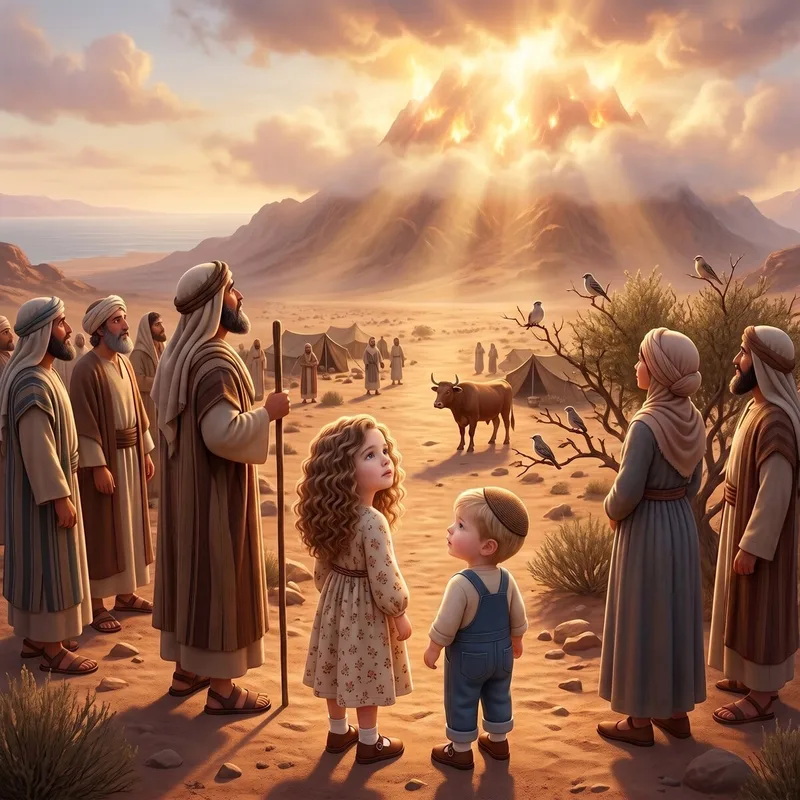
The Midrash relates that no bird chirped and no fowl flew. No ox lowed. The ofanim did not fly, and the seraphim did not say Kadosh. The sea did not stir, and no creature spoke. The world was silent and still.
And then the voice went out and said, 'Anochi Hashem Elokecha.' That is how the Aseres HaDibros begin (Shemos 20:2).
Where does this midrash come from?
It comes from Shemos Rabbah 29:9, in the Midrash on Parshas Yisro. It is a comment on the words 'Vayedaber Elokim es kol hadevarim ha'eileh leimor' (Shemos 20:1). The pasuk tells us that Hashem spoke. The Midrash gives us a picture of the stillness all around that moment.
It helps to keep the two layers apart when you tell it. The thunder, the cloud and the shofar are in the pesukim. The silence of the birds, the animals, the sea and the malachim is the Midrash. Children are happy to hear 'the Midrash tells us', and it teaches them early that Chazal give us more than the pesukim say.
What is the lesson of the quiet world?
The simplest lesson is that listening to Torah begins with stillness. We learn from this that when something important is being said, we stop what we are doing and make room to hear it. A child who can pause, face the speaker and be quiet is practicing something real.
There is also a gentle point about kavod haTorah. The whole world is described as holding still, from the smallest bird to the sea. That gives children a feeling for how precious the moment was, without any need for a big explanation.
You can bring this home in everyday places:
- When Abba or the rebbi begins to learn or tell a story.
- During tefillah, when the room is meant to be quiet.
- When a grandparent speaks and the children are still moving around.
How do I explain it to a 3-year-old, a 6-year-old and a 10-year-old?
Around 3 to 4: Tell it in two sentences. 'When Hashem gave us the Torah, even the birds stopped chirping. Everything was quiet so everyone could listen.' Then try it together: 'Can we be as quiet as the birds for five seconds?' Little children learn through doing, and this midrash gives you a game with meaning.
Around 6 to 7: Name the animals and ask your child to picture each one. A bird that does not chirp, an ox that does not low, the sea that does not move. Ask, 'Why do you think everything went quiet?' Let your child give an answer before you add anything. Most children say something like 'so they could hear,' and that is exactly the right place to start.
Around 9 to 12: Older children can handle the difference between pshat and midrash. Ask what we learn about listening from the silence that comes before 'Anochi.' Ask, too, how it feels to listen with your whole attention instead of half listening. You can also look together at Shemos 19 and 20 in the pesukim, and see where the Midrash fits into the story the Torah tells. If it interests them, the midrash of the mountains who wanted the Torah is another story from Chazal about the same event.
What is a personalized Torah Tale book of this story like?
This story is in the Midrash & Aggadah collection, which tells the stories Chazal relate behind the pesukim, each from its named source in the Gemara or Midrash. The book follows what the source says and does not add to it. Your child's name and, from one uploaded photo, their likeness appear on every page, in a high-resolution 3D animated-film style. Up to eight siblings can appear in the same book.
Every book ends with a discussion page of 10 questions about the story, mixing comprehension with middos. That turns the book from something read to your child into something talked about at the table. Read it on a Shabbos afternoon, and the questions are ready when you are.
The formats are a 6x6 board book with rounded safety corners for ages 0-4, an 8x8 softcover for ages 4-8, and an 8x8 hardcover for ages 5-18. Softcover and hardcover open with a dedication page. If you add parents, grandparents or other relatives with their photos, they appear with the children on a closing family page in every format. You can also choose English, Hebrew or Yiddish. Each book is written with careful rabbinical guidance and strict tznius, and reviewed by our team before it goes to print.

Softcover 8″×8″

Hardcover 8″×8″

Board book 6″×6″

Coloring book 8.5″×11″
What questions can we ask at the Shabbos table?
Reading is a lovely thing to do on Shabbos, and this story needs nothing but talking and listening. Try a few of these:
- Which animal in the Midrash did you picture first, and what was it doing?
- Why do you think the world went quiet before Hashem spoke?
- What are the first words that came after the silence?
- When is it hardest for you to be quiet and listen?
- What is something Abba or Ima says that you want to hear with your full attention?
You can also try a quiet minute at the table. Everyone stays still, and then each person says one thing they heard in the stillness. It costs nothing, takes a minute, and gives children a real sense of what listening feels like.
If your child loves to color, the matching coloring book (8.5x11, black-and-white line art) is an optional add-on to a one-time book order. Coloring is melacha, so keep it for a weekday afternoon or erev Shabbos, never for Shabbos or Yom Tov itself. It can also be used on Chol HaMoed.
When is a good time to read this story?
Any time works, because the lesson about listening is not tied to a date. It fits especially well around Shavuos and when Parshas Yisro is read, since the Midrash is about Matan Torah. The Shavuos story for kids and Parshas Yisro for kids give the background in the pesukim, and this Midrash adds what the world was doing at that moment.
When you are ready to give your child a book about it, create the book. It takes a free account and a few short questions: each child's name, boy or girl, age and one photo, any siblings, the story, your community, the language and the format. The whole flow takes about five minutes.
Frequently asked questions
What is the midrash of the day the whole world was quiet?
It is a Midrash in Shemos Rabbah 29:9 about Matan Torah. Chazal tell us that when Hashem gave the Torah, no bird chirped, no fowl flew, no ox lowed, the ofanim did not fly, the seraphim did not say Kadosh, the sea did not stir, and no creature spoke. The world was silent and still, and then the voice went out and said 'Anochi Hashem Elokecha'.
Is the world being silent at Matan Torah written in the pesukim?
No. The Torah describes thunder, lightning, a thick cloud and the sound of a shofar at Har Sinai (Shemos 19:16), and then says 'Vayedaber Elokim' before the Aseres HaDibros (20:1). The silence of the whole world is from the Midrash in Shemos Rabbah, so it is good to say 'the Midrash relates' when you tell it to children.
What is the lesson of the day the whole world was quiet?
We learn from this that hearing Torah starts with stillness. When something important is being said, we put down what we are doing, stop talking, and listen carefully. Children can practice this at a Shabbos table, in cheder or school, and during tefillah.
How do I explain this midrash to a 4-year-old?
Keep it short and concrete: 'When Hashem gave us the Torah, even the birds stopped chirping and everything was quiet, so everyone could hear.' Then let your child make the quiet with you for a few seconds. Young children usually grasp the picture of a very quiet world more easily than any idea behind it.
Which Torah Tale format suits this story?
Torah Tale offers a 6x6 board book with rounded safety corners for ages 0-4, an 8x8 softcover for ages 4-8, and an 8x8 hardcover for ages 5-18. Pick the one that matches your child's age, since age is one of the short ordering questions. Every book ends with a discussion page of 10 questions about the story.