The Arizal for Kids: Tzfas, Shabbos & How to Explain Him
The Arizal, Rabbi Yitzchak Luria, lived only about 38 years but shaped how Yidden welcome Shabbos. Here is his story for children, the lesson, and how to talk about it at home.
Published by Torah Tale.
Create this book for your child
The Arizal, Rabbi Yitzchak Luria, was a tzaddik who lived in Tzfas about five hundred years ago and taught Yidden to welcome Shabbos with joy and to daven with real kavanah. Children connect to him through something they already know: getting ready for Shabbos. His story is also a good first lesson that a person can be very deep in Torah and still be gentle, humble and warm.
Who was the Arizal?
The Arizal's name was Rabbi Yitzchak, and he is also called Rabbi Yitzchak Luria Ashkenazi. He is known as the Ari HaKadosh, the holy lion. The letters of Ari come from his name and title, and the word ari also means a lion. The traditional accounts say he was born in Yerushalayim in the year 5294 (1534).
Those accounts tell us his father passed away while he was still a child, and he grew up in Mitzrayim in the home of his uncle. There he learned Torah from the Rabbanim of the time. He grew into a young man known for learning, quiet and middos.
What happens in the story of the Arizal, for children?
Here is the story as it is usually told. As a young man in Mitzrayim, the Arizal spent years in a quiet house by the Nile, learning and davening in solitude. The accounts of his life say he came home to his family only for Shabbos. He used the quiet to learn, to daven and to think about the deepest parts of the Torah.
Then he made aliyah to Eretz Yisrael and settled in Tzfas in about 1570. Tzfas was a city full of Torah, and Rav Yosef Karo, the author of the Shulchan Aruch, lived there around the same time. You can read more about him in our article on Rabbi Yosef Karo and the Shulchan Aruch.
In Tzfas the Arizal gathered a circle of talmidim, with Rav Chaim Vital as the main one. He was niftar on 5 Av 5332 (1572), when he was about 38 years old. That is a very short life for such a lasting influence.
Why is the Arizal connected to Shabbos?
Shabbos is the part of the Arizal's story children can see and feel. The tradition of Tzfas is that on Friday afternoon the Arizal and his talmidim went out to the fields, dressed for Shabbos, to greet it with song, as we sing in Lecha Dodi, composed in Tzfas by Rav Shlomo Alkabetz. Many of the Shabbos zemiros that Yidden sing at the table, such as Azamer Bishvachin and Asader Liseudasa, are attributed to the Arizal as well.
For a child, this turns Shabbos into something to look forward to. It is a guest to welcome, not just a day when certain things are not allowed. That fits well with the pace of a Friday at home: tidying up, the challah, the Shabbos licht and the first song when Abba comes home from shul. For more on that moment, see Shabbos with My Family.
What is the lesson for a child?
There are a few lessons, and parents can choose the one that suits their child.
- Hachanah: greeting Shabbos is a real event, and we get ready for it with care.
- Simcha: a mitzvah done with joy is different from one done to get it over with.
- Kavanah: the Arizal taught his talmidim to think about the meaning of their tefillos and mitzvos, so a child can try to mean even one bracha.
- Humility: the Arizal wrote very little himself, and much of what we know of his Torah was recorded by his talmidim, especially Rav Chaim Vital.
How do I explain the Arizal to a 4-year-old, a 7-year-old and an 11-year-old?
At about 4: say, 'The Arizal was a very holy Rav in Tzfas who loved Shabbos. He and his talmidim sang to welcome it.' Then sing a Shabbos song together and point to the candles. That is enough.
At about 7: tell the story in order. The Arizal grew up in Mitzrayim, learned Torah, moved to Tzfas, and taught talmidim like Rav Chaim Vital. Ask, 'What do we do to get ready for Shabbos?' and 'How can we make our table a place that welcomes Shabbos?'
At about 11: explain that the Arizal's teachings are part of Kabbalah, the hidden side of the Torah, and that the study of Kabbalah is traditionally approached with great care, so a child does not need the details. What an older child can understand is the idea that a mitzvah has an inner side, and that kavanah matters. If your child asks deeper questions, it is a good moment to say, 'Let's ask our Rav or Rebbi.'
What is the personalized Arizal book like?
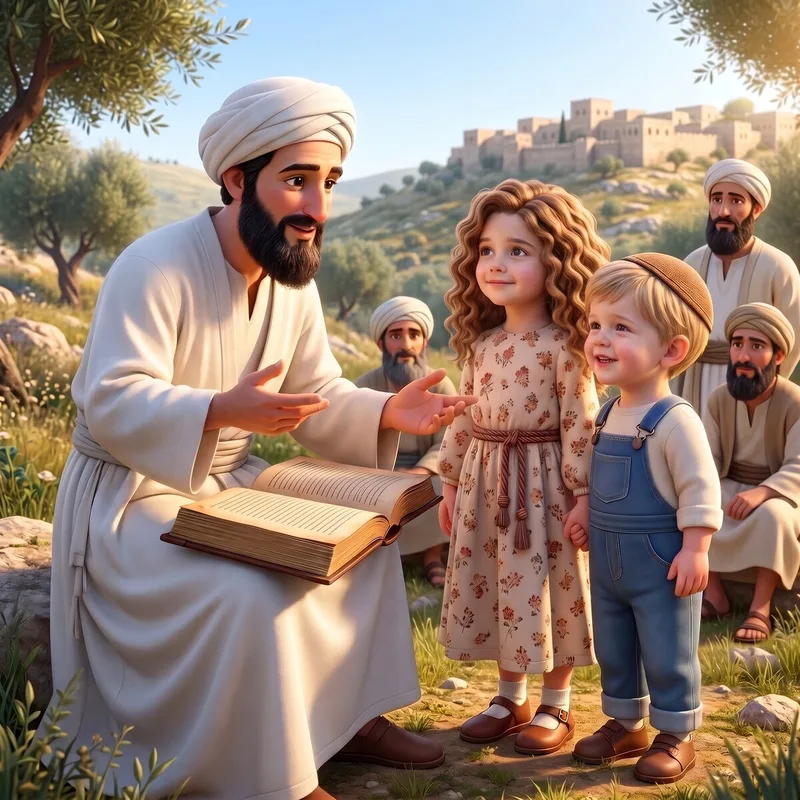
Torah Tale's Arizal book belongs to the Stories of Tzaddikim collection. In this book your child appears by name, with their likeness taken from one uploaded photo, in high-resolution 3D animated-film style. Up to eight siblings can appear in the same book, ages 0 to 18. If you add parents and grandparents, they appear with the children on a closing family page in every format.

Softcover 8″×8″

Hardcover 8″×8″

Board book 6″×6″

Coloring book 8.5″×11″
There are three formats: a 6x6 board book with rounded safety corners for ages 0-4, an 8x8 softcover for ages 4-8, and an 8x8 hardcover for ages 5-18. The softcover and hardcover open with a dedication page. An optional matching coloring book is available as an add-on, and it is a weekday activity, for an afternoon or erev Shabbos before candle lighting, never for Shabbos itself. Every book is written with careful rabbinical guidance and strict tznius, and reviewed by our team before it goes to print.
Every book ends with a discussion page of ten questions, mixing comprehension with middos. It helps the book become something the family talks about at the table, not only something read to a child. Reading a book like this at the Shabbos table or on a Shabbos afternoon is entirely appropriate.
What questions can we ask at the Shabbos table?
These are talking questions only, so they are fine for Shabbos itself. Pick two or three.
- What is the first thing we do at home to get ready for Shabbos?
- Why do you think the Arizal and his talmidim went out to greet Shabbos with a song?
- Which Shabbos song is your favorite, and what do the words say?
- What is one bracha or tefillah where you could try to think about the words this week?
- The Arizal wrote very little himself, and his talmidim carried his Torah forward. Who teaches you Torah?
On a weekday, a younger child can help set the table for Shabbos, and an older child can learn the words of a Shabbos zemer with a parent.
Ready to make it a book for your child?
The Arizal's story gives children a picture of a Shabbos welcomed with song and a Torah learned with humility. If you would like your child to be part of it, you can create the book in about five minutes with a free account and a few short questions: name, boy or girl, age, one photo, siblings, the story, your community, the language (English, Hebrew or Yiddish) and the format.
Frequently asked questions
Who was the Arizal, in simple words for a child?
The Arizal was Rabbi Yitzchak Luria, a great tzaddik and teacher of Torah who lived in Tzfas in Eretz Yisrael about five hundred years ago. He taught his talmidim to daven with deep kavanah and to welcome Shabbos with great joy. Children can remember him as the Rav who loved Shabbos and taught Yidden how special every mitzvah is.
Why is he called the Arizal and the Ari HaKadosh?
Ari is made from the first letters of his name and title, and the word also means lion. Ha'Kadosh means the holy one, and the letters ZaL stand for a blessing we say for a tzaddik who has passed away. Together they became the name Yidden have used for him for generations.
How old was the Arizal when he was niftar?
The traditional accounts say he was about 38 years old, and his yahrzeit is on 5 Av. He lived in Tzfas for only a short time, yet his talmidim carried his teachings to Yidden everywhere.
What is the lesson of the Arizal story for kids?
One lesson is hachanah, preparing carefully for Shabbos and for mitzvos, and doing them with simcha. Another is that a person who is quiet and modest can still teach Torah that reaches many Yidden. Parents can choose whichever fits their child's age and ask, 'How do we get ready for Shabbos in our home?'
How do I explain the Arizal to a 4-year-old?
Keep it very simple: the Arizal was a very holy Rav in Tzfas who loved Shabbos, and he and his talmidim sang to welcome it. Then connect it to your own home with the Shabbos licht, the challah and a song at the table. A child this age needs a picture and a feeling, not an explanation of kabbalah.
Does the personalized Arizal book work for different ages?
Torah Tale offers a 6x6 board book with rounded safety corners for ages 0-4, an 8x8 softcover for ages 4-8, and an 8x8 hardcover for ages 5-18. The child's age is one of the short questions when you create the book, and every book ends with a discussion page of ten questions about the story.