A Chasunah (חתונה) for Kids: Explaining the Jewish Wedding and Its Minhagim
A chasunah is a simcha the whole family shares in. Here is what children see at a Jewish wedding, what the minhagim mean, how to explain it by age, and what the Torah Tale book offers.
Published by Torah Tale.
Create this book for your child
A chasunah is a Jewish wedding, and for a child it is one of the most joyful things a family does together: a chuppah, singing, dancing and a seudah, all because a chasan and kallah are starting a Yiddishe home. Children love it because it is happy, loud and full of things to notice, and they learn from it that simchos are shared.
What happens at a chasunah?
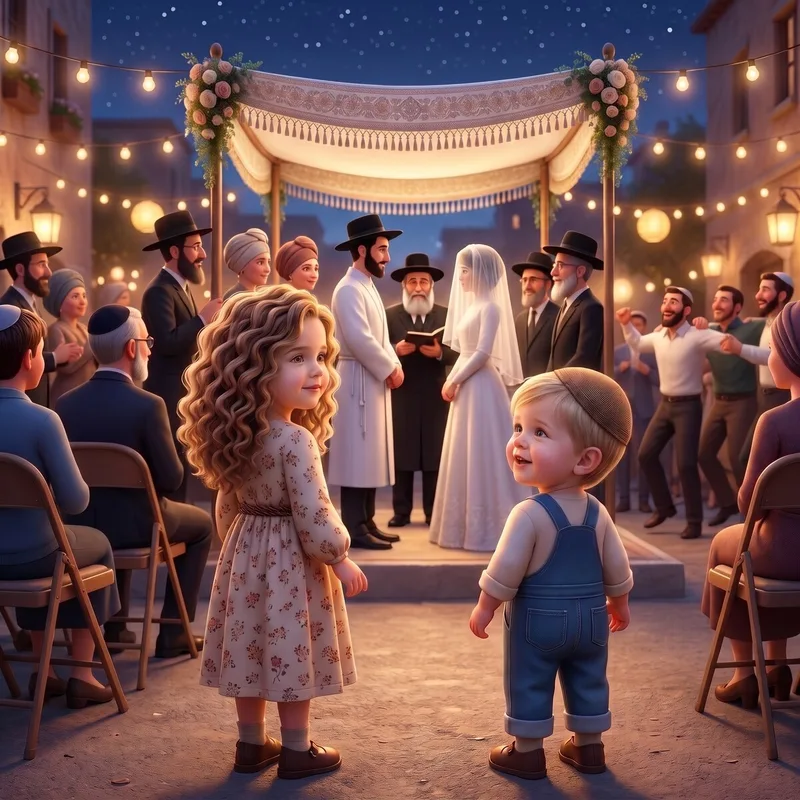
A chasunah has a few main parts, though minhagim differ between communities. The chasan and kallah are welcomed by family and friends, and then they stand under the chuppah, the canopy that represents the new home they are building.
Under the chuppah, the chasan gives the kallah a ring in front of witnesses, the kesubah is read, and the sheva brachos are said over a cup of wine. When the chuppah is over, everyone goes to the seudah, where there is food, music and dancing. In many communities the men and women dance on separate sides, and everyone, including the children, joins in the simcha in their own place.
In the week after the chasunah, friends and family often hold sheva brachos meals for the new couple. Ask your rav how your community keeps this.
Why do we break a glass and dance at a Jewish wedding?
Many of the minhagim carry a message children can understand. The glass that is broken is explained as a reminder of the Churban. Even at our happiest moment, we remember Yerushalayim and hope for the day Mashiach comes.
The dancing and singing come from a mitzvah. Chazal teach that gladdening a chasan and kallah is a real chesed, so guests are not just spectators. They come to give simcha. A child who sees grown-ups dancing with all their energy is learning that this is what a mitzvah looks like.
Weddings are not held on Shabbos or Yom Tov, which is something older children sometimes ask about. Shabbos and Yom Tov have a simcha of their own, and a chasunah has its own.
What is the lesson of a chasunah for children?
The lesson is being truly happy for someone else. A child may not be the center of attention at a wedding, and that is the point. The chasan and kallah are the stars, and a child's job is to say mazel tov, smile, and share in the simcha without wanting it to be about himself or herself.
It also shows that a Yiddishe home begins with Torah and Hashem at its center. The chuppah, the brachos and the sheva brachos all say the same thing: a family is built on something bigger than itself. Explaining this does not need a long speech, just a sentence like, "We celebrate because they are starting a home that will have Torah and mitzvos in it."
How do I explain a chasunah to a 4-year-old and to an older child?
For a 4-year-old, use a picture they can follow: "We are going to a very happy party. A chasan and kallah are getting married. We will see a chuppah, hear music, and dance. Our job is to say mazel tov and be happy." Tell them ahead of time about the noise and the crowd, and that they can stay close to you.
For a 7 or 8-year-old, add the meaning of what they see. The chuppah is the first part of a new home. The glass is broken to remember Yerushalayim. The dancing is a mitzvah, because we are gladdening the chasan and kallah.
For a child of 10 or 11, you can talk about the middos involved: ayin tovah, giving without expecting anything back, and what it means to be a good guest. They can also hear that the home the couple builds will be a place where Torah is learned and chesed is done, and that every family was once started this way.
If a wedding is coming up, a weekday evening before it is a good time to practice together: how to say mazel tov, where you will sit, and what to do if the music is too loud.
What is the Torah Tale book A Chasunah like?
A Chasunah is a story in the Jewish Life collection, the collection for the simchos and minhagim of a Yiddishe life. Your child is the hero: their name and, from one uploaded photo, their likeness appear on every page, illustrated in 3D animated-film style. It is written with careful rabbinical guidance and strict tznius and reviewed by our team before it goes to print.
Up to eight siblings can appear in the same book, which suits a family going to a wedding together. If you add parents, grandparents and other relatives with their photos, they appear with the children on a closing family page in every format. Softcover and hardcover books open with a dedication page.

Softcover 8″×8″

Hardcover 8″×8″

Board book 6″×6″

Coloring book 8.5″×11″
The formats follow the child's age: a board book 6x6 with rounded safety corners for ages 0-4, a softcover photo book 8x8 for ages 4-8, and a hardcover photo book 8x8 for ages 5-18. A matching coloring book 8.5x11 can be added to a one-time order, and it is a weekday activity, for example on an afternoon before a family wedding or on erev Shabbos. The storybook itself is a different matter: reading it at the Shabbos table or on a Yom Tov afternoon is entirely appropriate.
Which questions can we ask at the Shabbos table about a chasunah?
Every Torah Tale book ends with a discussion page of 10 questions that mix comprehension with middos, so what happened and what it asks of the child. That page can carry the conversation, and you can add your own questions, which need only talking:
- What do you remember seeing at a chasunah? What was your favorite part?
- Why do you think the chuppah is such an important part of the wedding?
- Why do we remember Yerushalayim even at a happy time?
- What can a child do to make the chasan and kallah happy?
- Is it easy to be happy when someone else is the center of attention? What helps?
Let children answer in their own words and let grandparents tell about weddings in the family. Younger children can simply point to what they remember. The conversation matters more than any particular answer.
Torah Tale also has stories about other family simchos, such as Bris Milah and Pidyon HaBen, which pair naturally with this one.
When you are ready, create the book. You need a free account and a few short questions about each child, the story, your community, the language (English, Hebrew or Yiddish) and the printed format, and the whole thing takes about five minutes.
Frequently asked questions
How do I explain a chasunah to a 4-year-old?
Keep it short and concrete: a chasunah is a very happy party where a chasan and kallah get married, and everyone comes to be happy with them. Tell your child what they will see, such as the chuppah, music and dancing, and what their job is, which is to say mazel tov and be happy for the chasan and kallah. A 4-year-old does not need the halachos, only a picture of what the day will look like.
Why do we break a glass at a Jewish wedding?
The custom is explained as a reminder of the Churban, so that even in a moment of great simcha we remember Yerushalayim. For children, you can say that we are so happy, but we never forget how much we hope for Mashiach and the Beis HaMikdash. Customs around when and how the glass is broken can vary, so ask your rav about your family's practice.
What is the lesson of a chasunah for children?
The main lesson is learning to be truly happy for someone else's simcha. Children learn that being mesameach a chasan and kallah is a mitzvah, and that it means giving of yourself: coming, dancing, smiling and saying mazel tov. It also teaches that a Yiddishe simcha has Hashem and Torah at its center.
What is the Torah Tale book A Chasunah?
A Chasunah is a personalized storybook in Torah Tale's Jewish Life collection, covering the simchos and minhagim of a Yiddishe life. Your child's name and, from one uploaded photo, their likeness appear on every page, illustrated in 3D animated-film style. Every book is written with careful rabbinical guidance and strict tznius, and it ends with a discussion page of 10 questions about the story.
Which format of A Chasunah suits which age?
Torah Tale offers a board book 6x6 with rounded safety corners for ages 0-4, a softcover photo book 8x8 for ages 4-8, and a hardcover photo book 8x8 for ages 5-18. A matching coloring book 8.5x11 can be added as a one-time add-on, and it is a weekday activity, for an afternoon during the week or erev Shabbos. The child's age is one of the short questions when you create the book.
Can I put several children in the same book?
Yes. Up to eight children, ages 0 to 18, can appear in the same book, which suits a family heading to a wedding together. If you add parents, grandparents or other relatives with their photos, they appear with the children on a closing family page in every format.