Tu B'Av for Kids: A Day of Simcha, Borrowed Clothes & Why We Celebrate
Tu B'Av is the fifteenth of Av, six days after Tisha B'Av. Here is how to tell it to children, what Chazal say about it, and how to explain it to a 4-year-old, a 7-year-old and a 9-to-12-year-old.
Published by Torah Tale.
Create this book for your child
Tu B'Av (ט״ו באב) is the fifteenth of Av, a day of simcha that comes just six days after Tisha B'Av. The Mishnah in Maseches Taanis describes it as one of the happiest days Yisrael ever had, and children connect to it because its picture is so simple: Yidden lending each other clothes so that no one would feel left out.
What is Tu B'Av and when does it fall?
Tu B'Av is the fifteenth day of the month of Av. Tu is simply the number fifteen written as the Hebrew letters tes and vav, the same way we say Tu B'Shvat. It falls in the summer, six days after the fast of Tisha B'Av, so a very sad day is followed soon after by a very happy one.
It is still months away, which makes this a calm time to learn it with your children so that they are ready when it comes around. You may like to read our article on Tisha B'Av for kids alongside this one, since the two days belong together.
What happens on Tu B'Av? The story for children
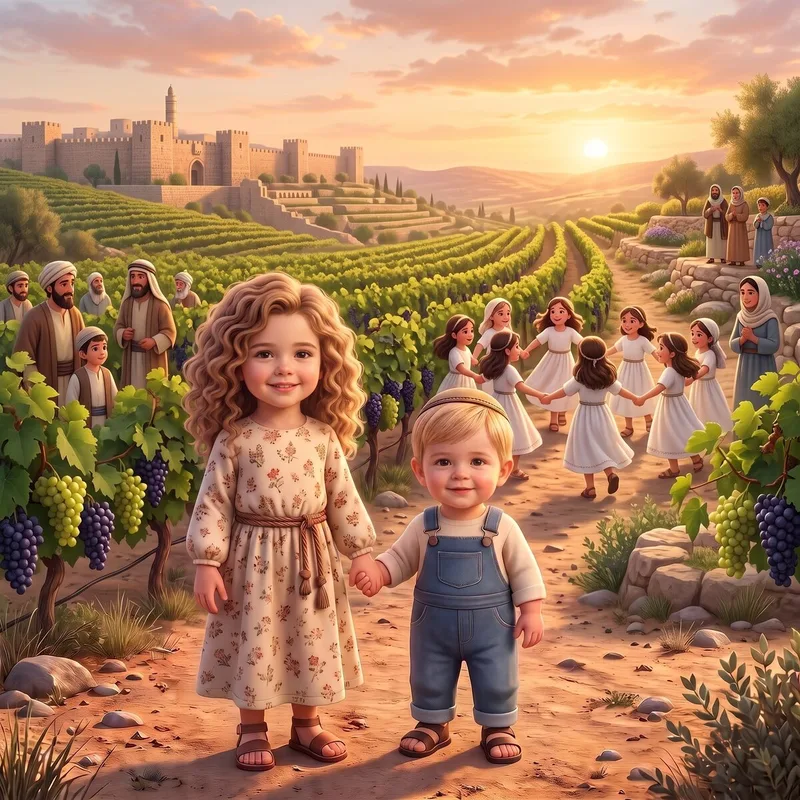
The Mishnah (Taanis 4:8) brings the words of Rabban Shimon ben Gamliel, who said that there were no days better for Yisrael than the fifteenth of Av and Yom Kippur. On Tu B'Av, he says, the daughters of Yerushalayim went out in white garments that were borrowed. They were borrowed so that no one who did not have any would be embarrassed.
For young children it is enough to hold on to that one picture: everyone wore borrowed clothes, so no one stood out as having less.
That is the heart of the story to tell a child. A whole city was careful about one person's feelings, and the result was a day of joy.
Why do we celebrate Tu B'Av? The reasons Chazal give
The Gemara in Taanis (30b-31a) does not give just one reason for the simcha of the day. It lists several events that Chazal connect to the fifteenth of Av. Here are three that are easy to tell to children:
- The end of the dying in the midbar. After the cheit of the meraglim, the Torah tells us that the generation that left Mitzrayim would not enter Eretz Yisrael (Bamidbar 14). The Gemara relates that on Tu B'Av the dying stopped. The people were unsure they had counted the days correctly and kept watching the moon, until the full moon of the fifteenth showed them that the decree was over.
- Binyamin was allowed back. After a painful episode told at the end of Sefer Shoftim, Yidden had sworn not to give their daughters to Binyamin. The Gemara lists the day that the shevet of Binyamin was permitted to enter the community as one of the reasons for Tu B'Av.
- Shevatim could marry each other. The Gemara also lists the day that the shevatim were allowed to marry one another, a rule connected to the daughters of Tzlafchad in Bamidbar 36.
The Gemara lists further reasons as well. You can mention to older children that Chazal saw many good things coming together on this one day.
What is the lesson of Tu B'Av for kids?
The lesson children can hold is making sure no one feels embarrassed. The borrowed clothes were not about being fancy. They were about making everyone equal so that no one would feel less.
A second lesson is that Hashem turns a sad time into a happy one, and that after the grief of Tisha B'Av there is room for simcha. A third is simcha together: the Mishnah describes a whole community celebrating, not individuals on their own.
If you want to build this middah at home, our article on never embarrassing a friend and the one on loving every Yid give you everyday ways to talk about it.
Chazal also say something about the nights after Tu B'Av. In Taanis 31a the Gemara speaks of the nights beginning to grow longer from this time, and of adding Torah learning at night. It is a lovely, simple reason for a child to learn an extra few minutes in the evening.
How do I explain Tu B'Av to a 4-year-old, a 7-year-old and a 9-to-12-year-old?
Around age 4: Tell it in two sentences. Long ago the Yidden in Yerushalayim lent each other clothes so that no one would feel sad. Hashem gave them a happy day, and we try to be kind like that too.
Around age 7: Add the connection to Tisha B'Av. Tisha B'Av is a sad day, and six days later comes a happy one. Ask what he or she would do if a friend had nothing to wear to a simcha, and talk about how to share without making the friend feel small.
Around ages 9 to 12: Bring in the Gemara's reasons: the end of the dying in the midbar and Binyamin returning to the community. Ask why Chazal gave so many reasons for one day, and what it teaches us that a day of simcha could come from so many different good things.
What is a personalized Torah Tale book about Tu B'Av like?
Tu B'Av is part of the Holidays collection in the story picker. Your child's name and, from one uploaded photo, their likeness appear on every page, illustrated in 3D animated-film style. You can include up to eight children in one book, aged 0 to 18, which is helpful if you want all the siblings to read the story together.

Softcover 8″×8″

Hardcover 8″×8″

Board book 6″×6″

Coloring book 8.5″×11″
Torah Tale offers a board book (6"x6", rounded safety corners, ages 0-4), a softcover photo book (8"x8", ages 4-8) and a hardcover photo book (8"x8", ages 5-18). If you add parents and grandparents, they appear with the children on a closing family page in every format. Every book is written with careful rabbinical guidance and strict tznius, and reviewed by our team before it goes to print.
Every book also ends with a discussion page of 10 questions that mix comprehension with middos: what happened, and what it asks of the child. This is what turns a book that is read to a child into one that is talked about at the table. Reading it is entirely appropriate on Shabbos, so it can be part of a Shabbos afternoon or a quiet evening.
What can we do at home for Tu B'Av? Questions and a weekday activity
Here are questions you can ask at the Shabbos table. They are talking only, so they work on Shabbos:
- Why do you think the clothes were borrowed and not new?
- How do you think someone who had nothing to wear would have felt if everyone else had something?
- Tisha B'Av is sad and Tu B'Av is happy. Why do you think Chazal put them so close together?
- What is a small thing you can lend or share this week so that a friend feels included?
- What is something that made you happy together with other people?
For a weekday activity, let your child choose a game or a book to lend to a friend or a sibling, and talk about how to lend it so that the other child feels welcome and not like a guest. If you add the optional coloring book (8.5"x11", black-and-white line art), it is also a weekday activity, for an afternoon during the week or before Shabbos, never on Shabbos itself.
When you are ready, you can create the book in about five minutes. It takes a free account and a few short questions: each child's name, boy or girl, age and one photo, any siblings, the story, your community (asked once), the language and the printed format.
Frequently asked questions
What is Tu B'Av in simple words for a child?
Tu B'Av is the fifteenth of Av, a happy day that comes six days after the sad fast of Tisha B'Av. The Mishnah says it was one of the happiest days of the year for Yidden. You can tell a child that after a sad day, Hashem gives us a day of simcha.
Why do we celebrate Tu B'Av?
The Gemara in Taanis lists several reasons, such as the end of the dying of the generation in the midbar and Binyamin being allowed back into the community of Yisrael. The Mishnah also describes the simcha of the day in Yerushalayim, with borrowed white clothes worn so that no one would feel embarrassed. We learn from this to be happy together as one people.
What is the lesson of Tu B'Av for kids?
The clearest lesson is to take care that no one feels embarrassed or left out. The Mishnah says the borrowed clothes were worn so that no one who had none would be shamed. A second lesson is that Hashem turns sadness into simcha, and that we can celebrate together after a difficult time.
Is Tachanun said on Tu B'Av, and is it a Yom Tov?
Tu B'Av is not a Yom Tov with melacha restrictions, so ordinary weekday activity continues. Tachanun is not said on this day. If you want to know your family's or community's exact custom, ask your rav.
How do I explain Tu B'Av to a 4-year-old?
Keep it to one picture: the Yidden in Yerushalayim lent each other clothes so that nobody would feel sad or left out. Then connect it to something your child can do, such as sharing a toy or inviting a friend to join. Leave the longer reasons from the Gemara for when he or she is older.
Which Torah Tale format suits a Tu B'Av book?
Torah Tale has a board book (6"x6", ages 0-4, with rounded safety corners), a softcover photo book (8"x8", ages 4-8) and a hardcover photo book (8"x8", ages 5-18). Choose the one that matches your child's age. Every book ends with a discussion page of 10 questions about the story.