Menorah Meaning for Kids: From the Mishkan to Hanukkah
The word menorah means a lamp. Here is the difference between the seven-branched Menorah of the Mishkan and the Beis HaMikdash, the eight-light Chanukah menorah at home, and Zechariah's vision of a golden Menorah with two olive trees, explained the way a child can hold on to it.
Published by Torah Tale.
The word menorah means a lamp. The menorah meaning that most families are asking about covers two different lamps: the seven-branched golden Menorah that stood inside the Mishkan and the Beis HaMikdash, lit by the kohanim with pure olive oil, and the eight-light Chanukah menorah that every family lights at home. They are not the same object, and explaining the difference to a child takes about a minute once you know it yourself.
What did the Menorah in the Mishkan look like?
The Torah describes the Menorah in Parshas Terumah (Shemos 25:31-40). It was made of pure gold, mikshah achas, hammered out of one single block, not assembled from separate pieces. It had a central shaft with six branches, three on each side, seven lamps in all, and its cups were shaped like almond blossoms, with knobs and flowers along the branches.
Rashi, quoting the Midrash Tanchuma, tells us that Moshe Rabbeinu found the Menorah hard to make, and that Hashem told him to throw the block of gold into the fire, and it came out made. The Torah also says that Hashem showed Moshe the form of the Menorah (Shemos 25:40).
The Menorah stood inside the Kodesh, on the south side, opposite the Shulchan on the north. The Torah says that Aharon tended the lamps each morning and lit them toward evening (Shemos 30:7-8), and in Parshas Beha'aloscha the pasuk says the seven lamps shone toward the face of the Menorah (Bamidbar 8:2); Rashi explains that the wicks of the six outer lamps were turned toward the middle one. Sefer Melachim tells us that Shlomo HaMelech later made ten golden menoros for the Heichal, five on the right and five on the left (Melachim I 7:49).
What does the Menorah symbolize?
The simplest answer for a child is that the Menorah is light, and in the Torah light means Torah and wisdom. Mishlei says ki ner mitzvah veTorah ohr, a mitzvah is a lamp and Torah is light (Mishlei 6:23).
The Gemara asks the obvious question: does Hashem need our light? The answer there (Shabbos 22b) is that the Menorah was eidus, testimony to the whole world that the Shechinah rests among Yisrael. And the Gemara in Bava Basra 25b says that one who wants to become wise should turn south when davening, because the Menorah stood in the south.
So the Menorah is not a lamp that helps Hashem see. It is a lamp that tells us something: that Hashem's presence is here, and that Torah is what gives a person light.
Menorah vs chanukiah: what is the difference?
In modern Hebrew, the Chanukah lamp is called a chanukiah and the word menorah is kept for the seven-branched lamp of the Mikdash. In Yiddish and in English, almost everyone calls the Chanukah lamp a menorah. Both are correct in ordinary speech, and both refer to the same thing when someone says "light the menorah" on Chanukah.
| Menorah of the Mishkan and Beis HaMikdash | Chanukah menorah (chanukiah) | |
|---|---|---|
| Lights | Seven | Eight, plus a shamash |
| Where it stood | Inside the Kodesh, on the south side | At home, by the door or a window, following the family's minhag |
| Who lit it | Aharon and the kohanim | Every household |
| What it burned | Pure olive oil | Oil or candles; many have the minhag of olive oil |
| When | Tended in the morning, lit toward evening, every day | Eight nights of Chanukah |
One practical note: Chazal teach that a person should not make a copy of the keilim of the Beis HaMikdash, and the poskim discuss how this applies to a seven-branched menorah in a home. Families follow their own minhag and their rav.
What was Zechariah's vision of the golden Menorah?
Zechariah HaNavi, who lived in the time of the return to Yerushalayim and the building of the second Beis HaMikdash, was shown a Menorah of gold with a bowl on top, seven lamps, and tubes feeding each lamp, with two olive trees standing beside it (Zechariah chapter 4). The oil came on its own, without anyone carrying it.
When Zechariah asked what it meant, the malach gave him the words that families still say and sing: lo bechayil velo bechoach ki im beruchi amar Hashem Tzevakos, not by might and not by power, but by My spirit (Zechariah 4:6). The small group rebuilding the Beis HaMikdash felt weak and poor, and the vision told them that what they were building would stand because of Hashem, not because of their numbers.
That is why Zechariah's vision is the haftarah of the first Shabbos of Chanukah, which this year is Shabbos, December 5. On a second Shabbos Chanukah, like Shabbos, December 12, the haftarah is from Melachim I, about Shlomo's work in the Beis HaMikdash. We wrote the vision up on its own in Zechariah's Golden Menorah for Kids, and the Chanukah story itself is in The Chanukah Story for Kids.
Both stories exist as Torah Tale books with your own child in them: the Zechariah book sits in the Nevi'im collection and the Chanukah book in the Holidays collection, and every book ends with a discussion page of ten questions about the story, mixing comprehension with middos.
How do I explain the Menorah by age?
Three answers, each one short enough to say while a child is holding your hand on the way to shul.
- Ages 3 to 4: "A menorah is a lamp. Long ago there was a golden lamp with seven lights in Hashem's house, and the kohanim lit it every day. Our Chanukah menorah has eight lights, one for each night of the nes."
- Ages 6 to 7: "The Menorah in the Mishkan was made out of one piece of gold, all in one piece, and it burned pure olive oil. When the Yevanim made the Beis HaMikdash tamei, the Chashmonaim found one little flask of oil that was still sealed, enough for one day, and it burned for eight. That is why our menorah has eight lights and theirs had seven."
- Ages 9 to 12: Add the question the Gemara asks in Shabbos 22b: does Hashem need light? No. The Menorah was testimony that the Shechinah is among Yisrael. Then add Zechariah: a small, poor group rebuilding, and a vision of a Menorah whose oil arrived on its own, with the words "not by might and not by power."
Questions for the Shabbos table, Shabbos Chanukah included, when talking is the whole activity: Why do you think the Menorah had to be made from one piece of gold and not put together from parts? If Hashem does not need our light, who is the light for? What is something in our family that looks small but keeps going longer than anyone expected?

Softcover 8″×8″

Hardcover 8″×8″

Board book 6″×6″

Coloring book 8.5″×11″
How does this fit into Chanukah 2026 at home?
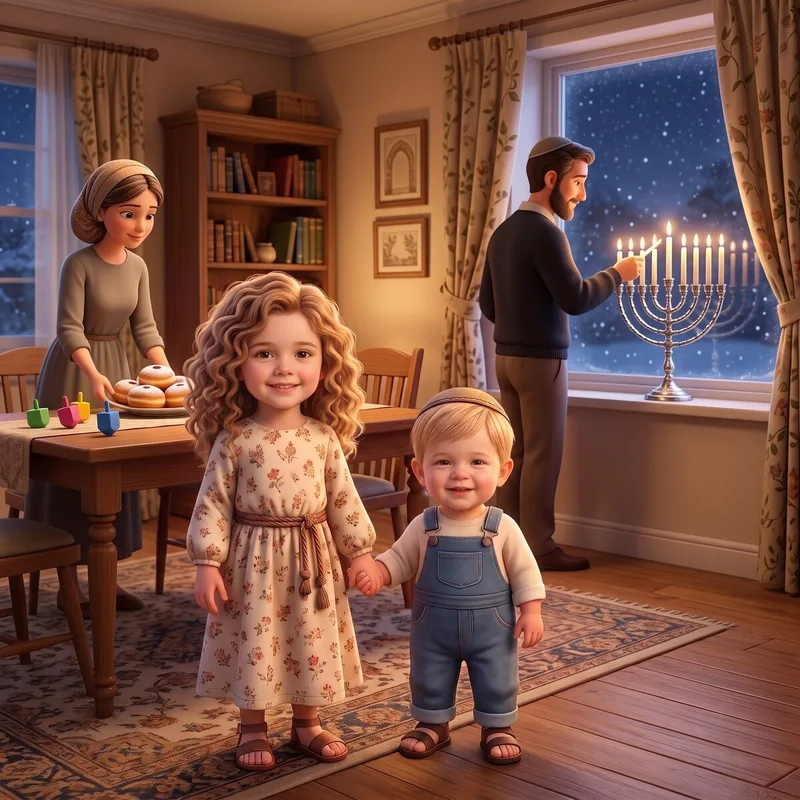
Chanukah 2026 begins on Friday evening, December 4, which is erev Shabbos, so that night the Chanukah licht are lit before the Shabbos candles. The eighth night, Friday, December 11, is erev Shabbos again, and Zos Chanukah falls on Shabbos, December 12. That gives two Shabbosos inside Chanukah this year, which is worth planning for; we laid it out night by night in Hanukkah on Shabbat 2026, and the practical side of lighting with children is in Menorah Lighting with Kids. For where to light, the order of havdalah and the licht on Motzei Shabbos, and the minhag of women not doing certain work while the candles burn, follow your own family's minhag and your rav.
Two Shabbosos also means two long afternoons when batteries and screens are not an option and a book is. Coloring, drawing and crafts belong to the weekday afternoons of Chanukah, not to Shabbos or to the first night.
Ordering a Chanukah book in time this year
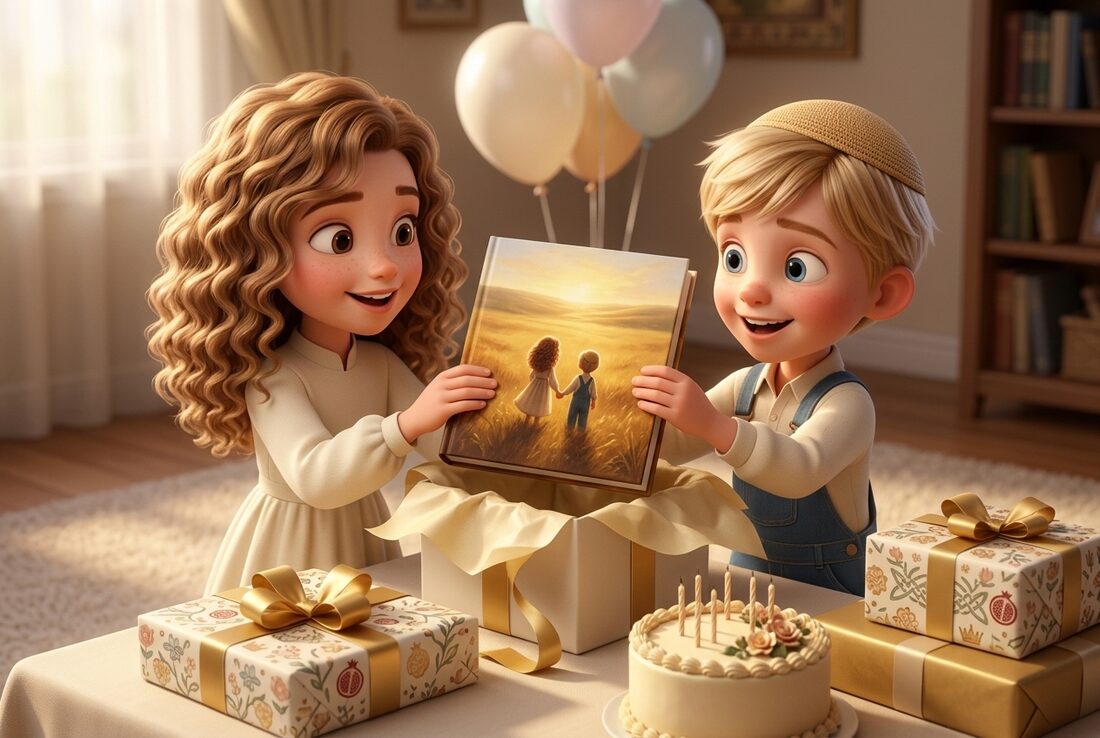
A Torah Tale book stars your own child: their name, and from one uploaded photo their likeness, illustrated in high-resolution 3D animated-film style on every page, with up to eight siblings ages 0 to 18 in the same book. Formats are the 6x6 board book with rounded safety corners for ages 0-4, the 8x8 softcover for ages 4-8, and the 8x8 hardcover for ages 5-18; softcover and hardcover open with a dedication page, and if you add parents and grandparents with their photos they appear with the children on a closing family page in every format. There is also an optional matching 8.5x11 coloring book in black-and-white line art, a weekday activity for the afternoons before and during Chanukah.
On timing: US standard shipping arrives in about 12 business days, counted from the order, and Thanksgiving on Thursday, November 26 is not a business day. Ordering now means aiming at one of the later nights rather than the first, and US express is faster once the book goes to print. We never promise a delivery date; if you are close to the wire, see Last-Minute Hanukkah Gifts That Still Arrive in Time.
Creating a book takes about five minutes: a free account and a few short questions, each child's name, boy or girl, age and one photo, any siblings, the story, your community (asked once), the language (English, Hebrew or Yiddish) and the printed format. If your child has been asking what the Menorah was, let them read a book where they are standing in the story. Create the book and pick the Chanukah story, or Zechariah's golden Menorah, from the story picker.
Frequently asked questions
What does the word menorah mean?
Menorah means a lamp or lampstand. In the Torah it is the name of the golden seven-branched lamp that stood inside the Mishkan and later in the Beis HaMikdash, which the kohanim lit with pure olive oil. In everyday speech today, people also call the eight-light Chanukah lamp a menorah.
What is the difference between a menorah and a chanukiah?
The Menorah of the Mishkan and Beis HaMikdash had seven branches, stood inside the Kodesh, and was lit by the kohanim with pure olive oil. The Chanukah lamp has eight lights plus a shamash and is lit at home, by every family, on the eight nights of Chanukah. In modern Hebrew the Chanukah lamp is called a chanukiah, while in Yiddish and English most people simply say menorah; both words refer to the same Chanukah lamp.
Why does the Chanukah menorah have eight lights?
When the Chashmonaim came back into the Beis HaMikdash they found one small flask of pure oil still sealed, enough for one day, and it burned for eight days until new oil could be brought. Chazal fixed eight days of Chanukah to publicize that miracle. We add one light each night, so the eighth night has eight lights, plus the shamash.
What does the Menorah symbolize?
The Menorah stands for light, and Chazal connect that light to Torah and to wisdom. The Gemara (Shabbos 22b) says Hashem does not need our light, and that the Menorah was testimony that the Shechinah rests among Yisrael. The Gemara in Bava Basra 25b says that one who wants wisdom should turn south when davening, because the Menorah stood on the south side of the Mishkan.
Can we keep a seven-branched menorah in our house?
Chazal teach that a person should not make a copy of the keilim of the Beis HaMikdash, and the poskim discuss how that applies to a seven-branched menorah made for a home. Practice differs between families and communities. Ask your rav before buying or making one.
When is Chanukah 2026 and how does the first night work?
Chanukah 2026 begins on Friday evening, December 4 (25 Kislev 5787), and the eighth night is Friday, December 11. Because both the first and the eighth nights fall on erev Shabbos, those nights the Chanukah licht are lit before the Shabbos candles. Zos Chanukah, the last day, is Shabbos, December 12.