Saying I'm Sorry (אומרים סליחה) for Kids: Teaching Apologies at Home
A practical guide to teaching children to say sorry, what a real apology includes, how to forgive, and questions for the Shabbos table, with the personalized Saying I'm Sorry storybook.
Published by Torah Tale.
Create this book for your child
Saying I'm Sorry (אומרים סליחה) is a Middos story about the everyday moment every child knows: you did something that hurt someone, and now you have to find the words. Children connect with it because it is not about a faraway figure but about the playground, the shared toys and the kitchen table, and because learning to apologize well is one of the most useful things a child can practice.
What is the Saying I'm Sorry story about?
Saying I'm Sorry is one of the stories in Torah Tale's Middos collection, which is about the good character a child grows, set in everyday life today. The story is about learning to say sorry, and the child who receives the book is the hero, with their own name and likeness on the pages.
That is the point of the Middos stories. A child does not meet an apology as an idea from long ago. They see themselves in a familiar moment, doing the harder thing and doing it well.
Why does the Torah care so much about saying sorry?
The Mishnah in Maseches Yoma (8:9) teaches that Yom Kippur atones for sins between a person and Hashem, but for sins between one person and another, Yom Kippur does not atone until he has appeased his friend. This is why apologizing is not a small politeness in our homes. It is part of teshuvah itself.
The Rambam (Hilchos Teshuvah, chapter 2) writes that a person who wronged his friend must make it right and ask for forgiveness. He also writes that the person who is asked should not be cruel, but should be easy to appease and slow to anger. A child needs both lessons, because every child is sometimes the one who hurt and sometimes the one who was hurt.
The Torah also records the brothers asking Yosef to forgive their wrongdoing (Bereishis 50:17). For another look at apologizing and honoring a friend, see our article on Rabban Gamliel of Yavneh and saying sorry.
What makes a real apology, not just a quick "sorry"?
Children often say "sorry" the way they say "fine": fast, flat, and mostly to end the conversation. A real apology can be taught in four short parts, and a child as young as four can begin to follow them.
- Say what you did. "I grabbed the truck out of your hands."
- Say that you are sorry. "I'm sorry I hurt you."
- Make it right. Give the truck back, help rebuild the tower, sit with the child who is crying.
- Say what you will try to do next time. "Next time I'll ask first."
These steps follow the same pattern as teshuvah: acknowledging what happened, regretting it, and making it right. You do not need to use any big words with a young child. Just keep the same order every time, so the pattern becomes familiar.
How do I explain saying sorry to a 3-year-old, a 6-year-old and a 10-year-old?
Ages 2 to 3. Keep it to a few words and an action: "You hurt Yossi. Let's see if he is okay. Say sorry and give him a hug if he wants one." At this age the feeling matters more than the words, so point out the other child's face: "Look, he is sad."
Ages 5 to 7. Children can now answer "How do you think he felt?" Let them think and answer before you do. Then ask, "What can you do to help him feel better?" Let the child choose the way to make it right.
Ages 9 to 12. Older children understand that "sorry, but you started it" is not an apology. Talk about the difference between explaining and excusing, and about how hard it is to apologize when you also feel hurt. This is also a good age to talk about forgiving: the Rambam's advice to be easy to appease is as much a challenge for a ten-year-old as for anyone.
What if my child won't say sorry?
Some children freeze or dig in, especially when they feel embarrassed. Pushing for the words in front of everyone can make it worse, and a forced mumble teaches the wrong lesson.
Try this instead: give a few minutes to cool down, then talk privately. Ask what happened, and then what the other child might have felt. Offer a smaller first step, like helping fix what was broken or bringing the other child a toy, and let the words follow when the child is ready.
Most important, let your child hear you say sorry. When a parent says, "I raised my voice, and I'm sorry," the child learns that grown-ups apologize too and that it does not make anyone smaller.
What is the personalized Saying I'm Sorry book like?
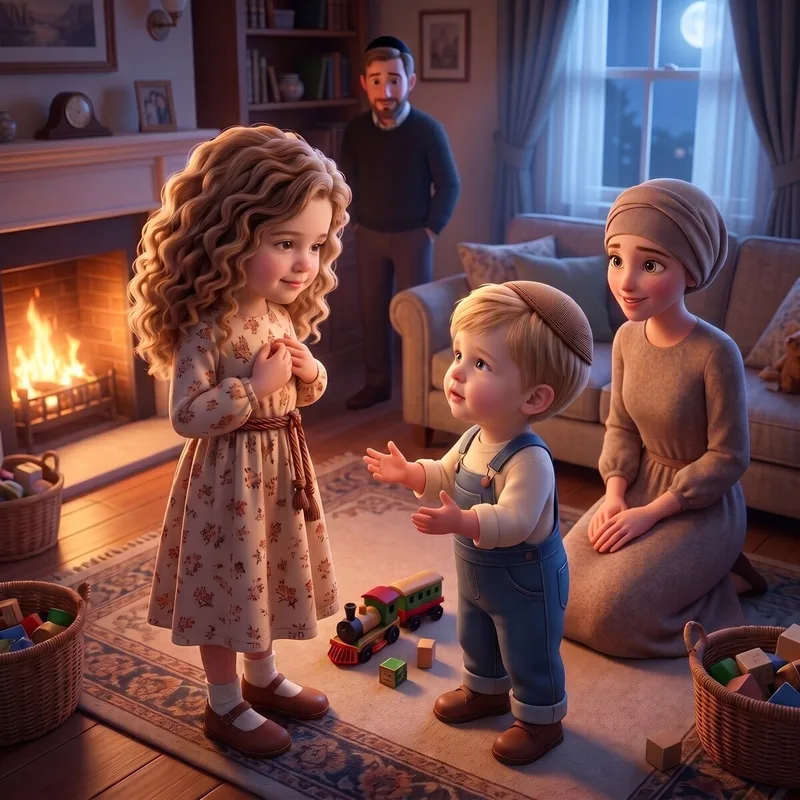
Your child's name and, from one uploaded photo, their likeness appear on every page, illustrated in 3D animated-film style. Up to eight children can appear in the same book, which suits a home where the arguments tend to be between siblings. Every book includes a discussion page at the end with 10 questions that mix comprehension with middos: what happened, and what it asks of the child.

Softcover 8″×8″

Hardcover 8″×8″

Board book 6″×6″

Coloring book 8.5″×11″
There are three formats. The board book is 6x6 with rounded safety corners, for ages 0-4. The softcover is 8x8, for ages 4-8, and the hardcover is 8x8, for ages 5-18. The softcover and hardcover open with a dedication page. If you add parents, grandparents or other relatives with their photos, they appear with the children on a closing family page in every format.
The creator asks a few short questions: each child's name, boy or girl, age and one photo, any siblings, the story, your community (asked once), the language and the printed format. A free account is needed, and the book can be ordered in English, Hebrew or Yiddish. Every book is written with careful rabbinical guidance and strict tznius, and is reviewed by our team before it goes to print.
What can we talk about at the Shabbos table?
A storybook is a good fit for Shabbos, since reading is entirely appropriate, and the table is a natural place for the conversation. These are talking questions only, no writing or drawing needed:
- Can you think of a time someone said sorry to you and it really helped? What did they say?
- Why is it sometimes hard to say sorry, even when we know we should?
- What is the difference between saying "sorry" and really making it right?
- When someone says sorry to us, how can we be easy to appease?
- Parents, tell about a time you had to say sorry, and how it felt afterward.
The book's own discussion page gives you 10 more questions, so you do not have to invent them yourself. If your children enjoy this theme, you may also like making peace with friends and never embarrassing a friend, which are both about how we treat each other when things get hard.
When you are ready, create the book and give your child a story where they get to practice saying sorry, and mean it.
Frequently asked questions
How do I teach my child to say sorry?
Start by modeling it yourself: when you snap at your child or make a mistake, say plainly what you did and that you are sorry. Then guide your child through the same steps after a conflict: what happened, who was hurt, what can I do to fix it. A story about apologizing, read when everyone is calm, gives the child words to use later.
At what age can a child understand an apology?
Toddlers can learn the habit of a short sorry together with a kind action, like a hug or helping pick up a toy. Around five to seven, children begin to understand why the other person felt hurt. Older children can learn that a good apology names what they did and offers to make it right.
Why does the Torah care so much about apologizing?
The Mishnah in Yoma (8:9) teaches that Yom Kippur atones for sins between a person and Hashem, but for wrongs against a friend one must first appease the friend. The Rambam in Hilchos Teshuvah (chapter 2) explains that the one who wronged another must make it right and ask forgiveness, and that the person asked should not be cruel but readily forgive. Saying sorry is therefore part of living as a Yid, not only a social nicety.
What should I do if my child refuses to say sorry?
Forcing a mumbled word usually teaches little. Give the child some time to calm down, then talk about how the other person felt and ask what could help them feel better. An action, a note given by a parent on a weekday, or sharing a toy can be a first step toward the words.
What is the personalized Saying I'm Sorry book?
It is a Torah Tale storybook in the Middos collection in which your child, with their name and likeness from one uploaded photo, is the hero of a story about saying sorry, illustrated in 3D animated-film style. It ends with a discussion page of 10 questions mixing comprehension with middos. Up to eight siblings can appear in the same book.