Rosh Chodesh for Kids: The New Moon, the First Mitzvah & a Fresh Start
Rosh Chodesh is the start of each Hebrew month and the first mitzvah given to Klal Yisrael as a nation. Here is the story, what we do that day, the lesson of a fresh start, and how to explain it to a 3-year-old, a 6-year-old and a 10-year-old.
Published by Torah Tale.
Create this book for your child
Rosh Chodesh is the first day of each Hebrew month, the day the new moon begins a new month, and it was the first mitzvah Hashem gave to Klal Yisrael as a nation. Children connect with it because they can watch it happen: the moon grows thin, grows full, and starts again. That makes it an easy way to teach a big idea, which is that every month is a fresh start.
What is Rosh Chodesh, in simple words?
The Hebrew calendar counts its months by the moon. A month is twenty-nine or thirty days, and Rosh Chodesh marks the start of the next one.
Some Rosh Chodesh days come as a pair. When the month that just ended had thirty days, its thirtieth day is also Rosh Chodesh, and the first of the new month follows it, so the two days together are Rosh Chodesh. Children often ask why Rosh Chodesh sometimes lasts two days, and that is the answer.
Rosh Chodesh is not a Yom Tov. It is a day with its own special character, which we will get to below.
How did Rosh Chodesh begin?
The Torah tells us that Bnei Yisrael were still in Mitzrayim when Hashem spoke to Moshe and Aharon and said, "HaChodesh hazeh lachem rosh chodashim, rishon hu lachem l'chodshei hashanah" (Shemos 12:2). This month is for you the head of the months. Rashi on Bereishis 1:1 brings Rabbi Yitzchak's teaching that this was the first mitzvah commanded to Yisrael as a nation.
On the words of the pasuk, Rashi brings from Chazal that Hashem showed Moshe the moon as it is renewed and told him that this is how he should see it and sanctify the month. It is often taught that the word lachem, "for you," reminds us that time is given to us to use well.
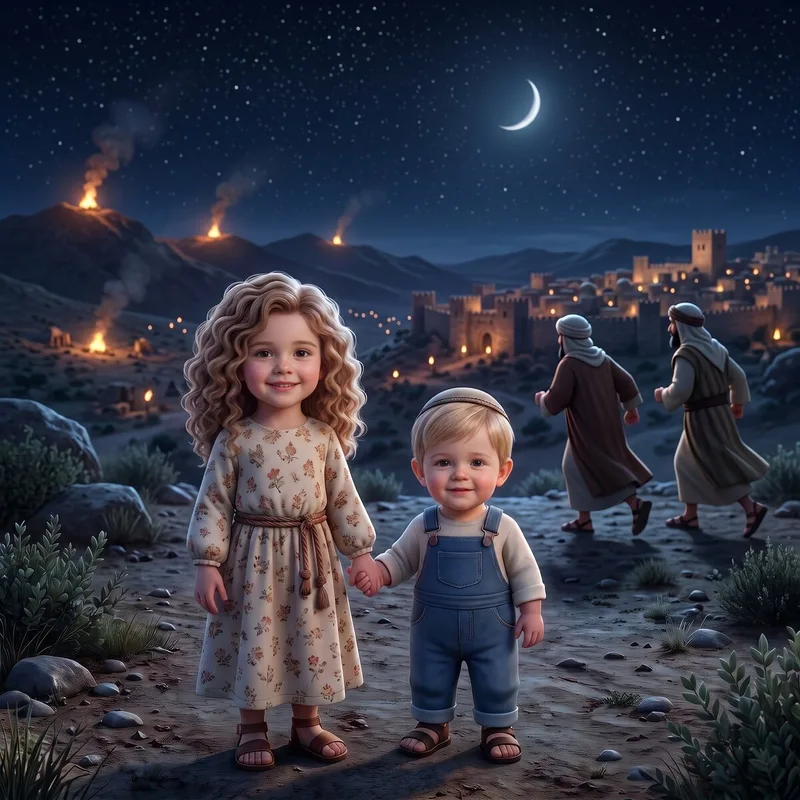
Later, the months were sanctified by the Beis Din. Witnesses who saw the new moon came to testify, and the Beis Din declared the month sanctified. The Mishnah describes how the news was passed along by signal fires on mountaintops. Later the calendar was set so that we know the dates ahead of time. For a story from the period of the Beis Din's authority over the calendar, see Rabban Gamliel of Yavneh for Kids.
What do we do on Rosh Chodesh?
Children notice the differences on Rosh Chodesh, so it helps to name them. Here are the main ones:
- Yaaleh V'yavo. We add it to davening and to Birkas HaMazon.
- Hallel. After Shacharis we say a shortened Hallel with a bracha.
- No Tachanun. We skip it because the day has a lighter, more joyful feeling.
- The Torah reading. On a weekday Rosh Chodesh we take out the Sefer Torah and read about the korbanos of Rosh Chodesh from Parshas Pinchas (Bamidbar 28:1-15).
- Musaf. We daven Musaf, which recalls the additional korban of Rosh Chodesh.
- A festive feeling. Many families make the meal a little special, as a minhag.
Many women also have a custom to refrain from certain kinds of work on Rosh Chodesh. The Midrash (Pirkei DeRabbi Eliezer) relates that this is connected to the women not giving their jewelry for the eigel. Customs differ between families and communities, so ask your rav what is right for yours.
What is the lesson of Rosh Chodesh for a child?
The main lesson is renewal. A month has passed, with its good days and its harder ones, and now there is a new one. The moon is a picture a child can see: it becomes small, and then it returns.
The Kiddush Levana text says that Klal Yisrael is destined to be renewed like the moon. You can find a gentle explanation in Kiddush Levana for Kids.
A second lesson is that time is a gift. Rosh Chodesh invites a child to choose one small thing for the new month, such as saying Modeh Ani right away in the morning or helping set the table. A small, specific goal is easier for a child to keep than a big promise.
How do I explain Rosh Chodesh to a 3-year-old, a 6-year-old and a 10-year-old?
- Ages 3 to 4: "Look at the moon. It gets thin and then it grows again. Hashem gave us a special day when the new month starts." One image, one sentence, and a point at the sky.
- Ages 6 to 7: Tell them that the first mitzvah Klal Yisrael ever got as a nation was about the new moon, before they even left Mitzrayim. Explain that our months follow the moon, which is why Rosh Chodesh sometimes lasts two days.
- Ages 9 to 12: Talk about the witnesses and the Beis Din who sanctified the month, and how the signal fires carried the news. Ask why Hashem might have given a mitzvah about time to a people who had just left a place where they had no control over their own time.
What is the Torah Tale book about Rosh Chodesh like?
The Rosh Chodesh book is in our Holidays collection. Your child is the hero: their name and, from one uploaded photo, their likeness appear on every page, illustrated in a high-resolution 3D animated-film style. Up to eight siblings, ages 0 to 18, can appear in the same book. If you add parents and grandparents, they appear with the children on a closing family page in every format.
Every book is written with careful rabbinical guidance and strict tznius, and is reviewed by our team before it goes to print. It can be ordered in English, Hebrew or Yiddish.
There are three formats. A 6x6 board book with rounded safety corners is for ages 0-4. An 8x8 softcover photo book is for ages 4-8, and an 8x8 hardcover photo book is for ages 5-18. The softcover and hardcover open with a dedication page. An optional matching coloring book is also available as an add-on.

Softcover 8″×8″

Hardcover 8″×8″

Board book 6″×6″

Coloring book 8.5″×11″
Every book ends with a discussion page of 10 questions, mixing comprehension with middos. That page is what turns the book from something read to a child into something talked about at the table.
What can we ask and do on Rosh Chodesh?
These questions work at the table on Rosh Chodesh, or on any Shabbos near it. They need only talking, so they fit Shabbos as well:
- What happens to the moon during the month?
- Why do you think the first mitzvah Klal Yisrael received was about a new month?
- What is one small thing you would like to do better this month?
- What did you do well last month that you want to keep doing?
A simple activity is to look up at the moon together in the evening during the first days of the month, and then again a week later, and notice how it has changed. You can do this any evening. A book is also a good Shabbos reading: reading is entirely appropriate on Shabbos, and a story about Rosh Chodesh is one a child can listen to at the Shabbos table.
If you add the optional coloring book, keep it for a weekday afternoon or erev Shabbos, never for Shabbos itself, since coloring is melacha.
The next Rosh Chodesh after this article is Rosh Chodesh Teves, which always falls during Chanukah. For Chanukah timing see Hanukkah 2026: When Chanukah Starts and the 8 Nights. If you want a book for a particular day, remember that US standard shipping arrives in about 12 business days from the order, so plan ahead.
When you are ready, you can create the book with a free account and a few short questions: your child's name, boy or girl, age and one photo, any siblings, the story, your community (asked once), the language and the format.
Frequently asked questions
What is Rosh Chodesh in simple words for a child?
Rosh Chodesh is the first day of a new Hebrew month. The Hebrew months follow the moon, so each one begins when the moon is new. It is a special day with extra tefillos, and it reminds us that we can start fresh.
Where is Rosh Chodesh in the Torah?
The mitzvah of sanctifying the new month is in Shemos 12:2, where Hashem tells Moshe and Aharon in Mitzrayim, "HaChodesh hazeh lachem rosh chodashim." Rashi on Bereishis 1:1 brings the statement of Rabbi Yitzchak that this was the first mitzvah commanded to Yisrael as a nation. The korbanos of Rosh Chodesh are in Bamidbar 28:11-15, in Parshas Pinchas.
How do I explain Rosh Chodesh to a 4-year-old?
Point to the moon and say that it gets thin and then grows bigger again, and that Hashem made it so that we can count the months. Then say that when the moon starts again, we have a special day called Rosh Chodesh to say thank you and begin fresh. Keep it to one idea and let your child ask the rest.
What is the lesson of Rosh Chodesh for kids?
The lesson is renewal: every month is a new beginning, and a child can choose one small thing to do better. The Kiddush Levana text also says that Klal Yisrael is destined to be renewed like the moon. It also teaches that time is a gift from Hashem to use well.
Which Torah Tale format suits a Rosh Chodesh book?
The format follows your child's age. Torah Tale offers a 6x6 board book with rounded safety corners for ages 0-4, an 8x8 softcover photo book for ages 4-8 and an 8x8 hardcover photo book for ages 5-18. Every book ends with a discussion page of 10 questions mixing comprehension with middos.