Rashi (רש״י) for Kids: Who He Was & How to Explain Him
Rashi is a Rishon whose words sit beside the pesukim in the Chumash. Here is who he was, what he wrote, the middos he teaches, and how to explain him to a 3-4, 6-7 and 9-12 year old.
Published by Torah Tale.
Create this book for your child
Rashi is Rabbi Shlomo Yitzchaki, a Rishon who lived in Troyes, France, about a thousand years ago and wrote the commentary printed beside the pesukim in the Chumash. Many children first meet him in cheder, when the rebbi says, "Let's see what Rashi says."
He lands well with children because he is the kind of teacher who answers a question every child asks: what does this word mean? Here is his story, what he wrote, and how to explain him at different ages.
Who was Rashi and when did he live?
Rashi was born in Troyes around the year 1040 and passed away in 1105, on 29 Tammuz. His name is made from the first letters of Rabbi Shlomo Yitzchaki, meaning Shlomo, the son of Yitzchak. He is counted among the Rishonim, the great early authorities who came after the Geonim.
Rashi's own teachers were students of Rabbeinu Gershom Me'or HaGolah. If your child enjoyed that story, you can read about Rabbeinu Gershom, or about Rabbeinu Chananel, another Rishon of the same period.
What is the story of Rashi, retold for children?
Rashi grew up in Troyes and learned Torah from a young age. As a young man he traveled to the yeshivos of Mainz and Worms, where he learned from the students of Rabbeinu Gershom. Then he returned to Troyes, where he taught talmidim and where Yidden brought him their questions.
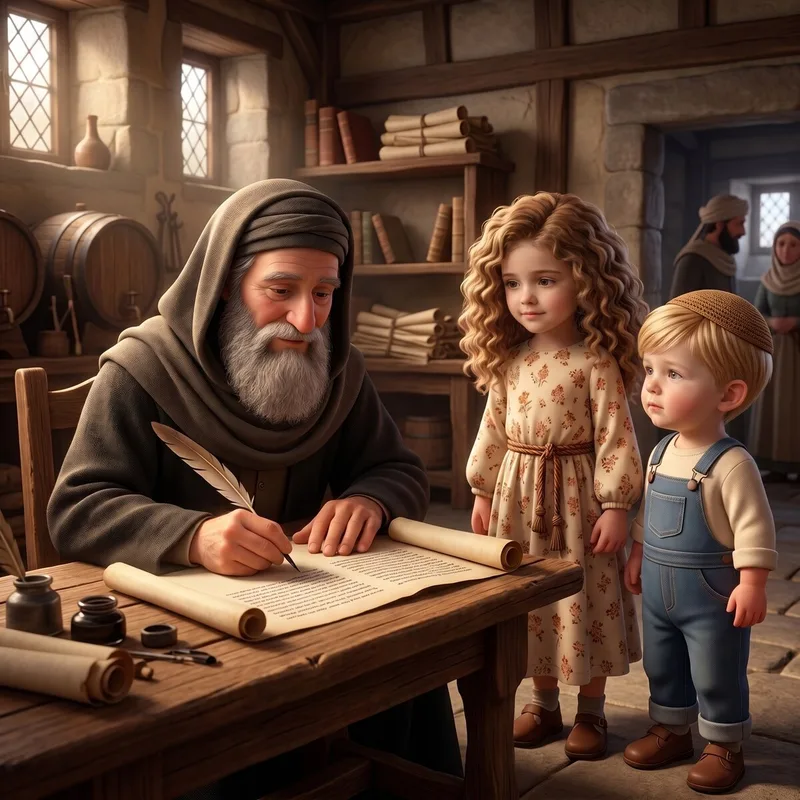
Rashi wrote a peirush, a commentary, on the Torah and on most of the Gemara. A peirush is a bit like a good teacher standing next to you at the page, explaining a hard word or showing what Chazal teach about a pasuk. In the Gemara, Rashi's commentary is printed on the inner side of the page, right beside the text it explains.
Some of his commentaries were left unfinished. His grandson, the Rashbam, himself a great mefaresh, completed some of them. Rashi's learning continued through his family and his talmidim.
What did Rashi actually write?
- A commentary on the Torah, which is the one children meet first.
- A commentary on much of the rest of Tanach.
- A commentary on most of the Gemara.
In his commentary on Bereishis 3:8, Rashi says that he comes to explain the plain meaning of the pasuk and the Aggadah that fits the words. That is why a Rashi so often begins by quoting a few words from the pasuk, and then explains them.
Here is an example for older children. On the pasuk about Yaakov leaving Be'er Sheva (Bereishis 28:10), Rashi writes that when a tzaddik leaves a place, it makes an impression. We can read more about that journey in Parshas Vayeitzei for Kids.
What is the lesson of Rashi for kids?
Explain it so that others can understand. Rashi did not only learn; he wrote down clear explanations for others. Ask your child who explained something to them this week, and whom they could explain something to.
It is all right to say, "I don't know." In several places Rashi writes plainly that he does not know. A child who is afraid to admit it when something is hard can take comfort from that.
Keep learning. The Rashbam writes that Rashi told him that, if he had the time, he would write other commentaries, because new explanations of the plain meaning keep emerging. A person who has already learned a great deal still wants to keep learning.
Pass on what you were taught. Much of what Rashi writes is the words of Chazal, gathered and explained. This is a lovely way to teach hakaras hatov to rebbeim and parents, who gave us what they learned.
How do I explain Rashi to a 3-4, 6-7 or 9-12 year old?
Ages 3-4. Keep it short. "Rashi was a rebbi who helped everyone understand the Torah. When a word was hard, he explained it." Then ask, "Who explains things to you?"
Ages 6-7. Many children this age are starting Chumash. Open a Chumash and look for the Rashi under the pesukim. Show them that Rashi first quotes a few words from the pasuk and then explains them. Explain that the funny-looking letters are called Rashi script, and that the name comes from the way his commentary is printed, not from his own handwriting.
Ages 9-12. Talk about how Rashi works. He gives the pshat, the plain meaning, and sometimes brings in words of Chazal. Look at Rashi's first comment on Bereishis, where Rabbi Yitzchak asks why the Torah begins with creation instead of the first mitzvah given to Klal Yisrael, "HaChodesh hazeh lachem." Then read the answer together and let your child say it back in their own words.
What can we ask at the Shabbos table about Rashi?
Reading and talking are very much at home at the Shabbos table. Try these, with no writing or crafts:
- Why do you think Rashi explained the Torah in a way a student could follow?
- When was the last time you did not understand something? Whom did you ask?
- Rashi sometimes wrote that he did not know. Why is that a sign of greatness?
- Who is a rebbi or teacher you are thankful for, and why?
- If you could ask Rashi to explain one word in the parsha, which would you choose?
What is a personalized Torah Tale book about Rashi like?
Torah Tale makes a personalized storybook about Rashi, in the Stories of Tzaddikim collection, in which your child is the hero. Their name and, from one uploaded photo, their likeness appear on every page, illustrated in 3D animated-film style. Up to eight children, ages 0 to 18, can appear in the same book, and if you add parents and grandparents, they appear with the children on a closing family page in every format.
The book is written with careful rabbinical guidance and strict tznius, and our team reviews it before it goes to print. Every book ends with a discussion page of 10 questions about the story, mixing comprehension with middos, which turns a book that is read to a child into one that is talked about at the table. It is also a book that is good to read at the Shabbos table or on a Yom Tov afternoon.

Softcover 8″×8″

Hardcover 8″×8″

Board book 6″×6″

Coloring book 8.5″×11″
There are three formats. The board book is 6x6 with rounded safety corners, for ages 0-4. The softcover is 8x8, for ages 4-8, and the hardcover is 8x8, for ages 5-18. Softcover and hardcover open with a dedication page. The book comes in English, Hebrew and Yiddish. An optional matching coloring book is 8.5x11 in black-and-white line art. It is for a weekday, such as an afternoon or erev Shabbos, and never for Shabbos or Yom Tov.
Creating the book takes about five minutes. It needs a free account and a few short questions: each child's name, boy or girl, age and one photo, any siblings, the story, your community (asked once), the language and the format.
If you would like to give your child a story about a rebbi who explained the Torah so that others could understand it, you can create the book and make your child the hero.
Frequently asked questions
Who was Rashi, in a sentence a child can understand?
Rashi was a great rebbi named Rabbi Shlomo Yitzchaki who lived in Troyes, France, about a thousand years ago. He explained the words of the Torah and the Gemara so clearly that Yidden still learn from his explanations today. His name is made from the first letters of Rabbi Shlomo Yitzchaki.
What is the lesson of Rashi for kids?
The main lesson is to learn something well and then explain it simply so that others can understand it too. A second lesson is humility, because in several places Rashi writes plainly that he does not know. Children can also learn hakaras hatov from him, since much of what he writes is the words of Chazal, passed on and explained.
At what age can I start teaching my child about Rashi?
Many children meet Rashi when they begin learning Chumash with the commentary, but even a 3 or 4 year old can understand the idea that Rashi was a rebbi who explained hard words. Younger children need only a short sentence and a picture, while older children can look at an actual Rashi in the Chumash. Choose the length that fits your child.
What is the Rashi script, and did Rashi write that way?
Rashi script is the semi-cursive Hebrew type in which his commentary is usually printed, and it is named after him because of that. It is not Rashi's own handwriting. It is a fun fact for children who notice that the Rashi on the page looks different from the pesukim.
What does a personalized Torah Tale book about Rashi include?
The book stars your child, with their name and likeness from one uploaded photo, illustrated in 3D animated-film style. It is from the Stories of Tzaddikim collection and is written with careful rabbinical guidance and strict tznius. Every book ends with a discussion page of 10 questions mixing comprehension with middos, and a closing family page that shows any parents and grandparents you choose to add.
Which Torah Tale format suits a book about Rashi?
Choose by your child's age: the board book (6x6 with rounded safety corners) is for ages 0-4, the softcover (8x8) is for ages 4-8, and the hardcover (8x8) is for ages 5-18. The child's age is one of the few short questions when you create the book.