Moving to Our New Home (עוברים לבית חדש) for Kids
A move changes everything a child can see while the family stays the same. Here is how to explain it to a 3-4 year old, a 6-7 year old and a 10-12 year old, with the mezuzah, Chanukas HaBayis and questions for the Shabbos table.
Published by Torah Tale.
Create this book for your child
'Moving to Our New Home' (עוברים לבית חדש) is a story from the Family collection, which is about a child and the grown-ups who love them, set at home today. It lands with children because a move changes everything they can see, and the people who love them stay the same. This article covers what the story is about, how to talk to your child about a move at different ages, and what the Torah says about a new home.
What is the 'Moving to Our New Home' story about?
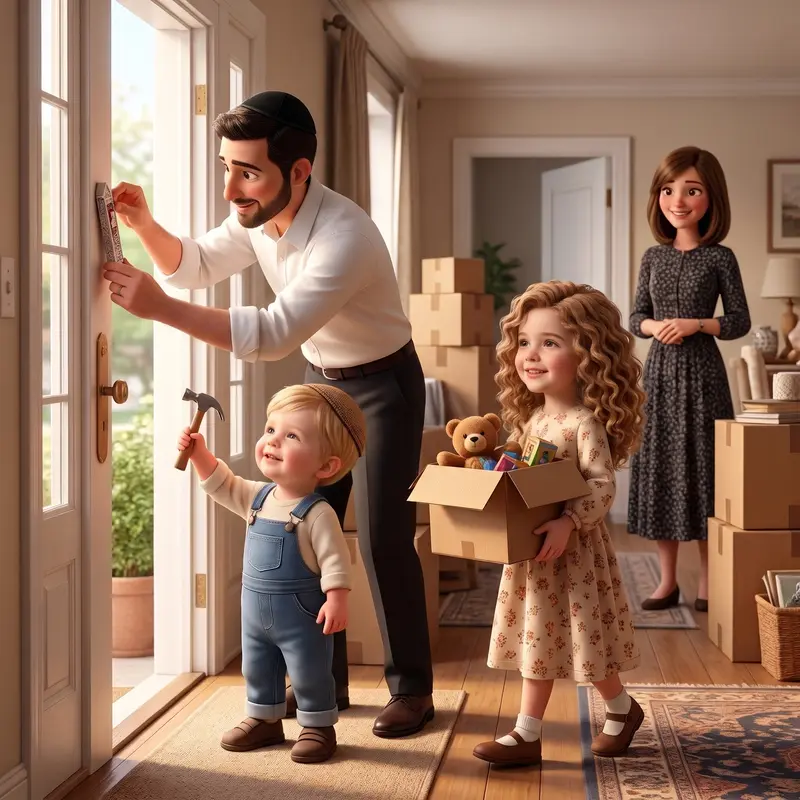
It is a story about a family settling into a new home. Stories in the Family collection show what a child and the grown-ups around them do together at home, and what a parent or grandparent teaches along the way. In a Torah Tale book, your child is the hero, with their name and likeness on every page.
Moving is a good subject for a child's book because it is so big and so ordinary at once. Children often cannot say what is bothering them, but they can point to a picture and say, 'That's me, and that's my room.' A story gives them something to point to.
How do I help my child feel at home in a new place?
Children usually feel a move through small things: a different bedroom, a new route to cheder or school, a kitchen that smells different. Here are a few things a parent can do that cost nothing.
- Keep the routines. Same bedtime, same Shema, same Friday-night brachos. The house is new, but the evening should feel the same.
- Set up the child's room first. Put their books, their bed and a familiar blanket in place before the living room is finished.
- Give a job. A child can carry their own light box or choose where a picture goes.
- Name the feeling. 'It is exciting and a little strange. That is normal.' Saying it out loud helps.
- Label boxes with your child on a weekday. Writing and drawing are melacha, so this is for a weekday afternoon, never for Shabbos or Yom Tov.
What does the Torah say about a new home?
The Torah tells us to write the words of Shema on the doorposts of our house and on our gates (Devarim 6:9, 'וכתבתם על מזוזות ביתך ובשעריך'). That is the source of the mezuzah, and it is why a mezuzah is part of settling into a new home. When exactly to put up the mezuzos depends on whether you own or rent and where you live, so ask your rav. You can read more in our article on the mezuzah on our door.
Many families also make a small Chanukas HaBayis, a gathering with a few words of Torah about what the home should be used for. Our article on Chanukas HaBayis for kids goes through it.
There is also a comfort for a child who is leaving a place. When Yaakov Avinu left home, Hashem promised him, 'והנה אנכי עמך ושמרתיך בכל אשר תלך' (Bereishis 28:15). When Yaakov woke, he said that Hashem is in this place. The meaning for a child is simple: Hashem is with us in the old home and in the new one. See Parshas Vayeitzei for kids for the full story.
How do I explain a move to a 3-year-old, a 7-year-old and a 12-year-old?
Ages 3 to 4. Keep it short and concrete. 'We are going to a new house. Mommy and Totty are coming. Your bed is coming. Your books are coming.' Read the same book several times, since repetition is how small children digest change. Let them carry something of their own into the new home on the first day.
Ages 6 to 7. This age wants to know the practical details: where will I sit in the car, who will be my friends, where is my cheder? Answer honestly, and say what you do not know yet. Let them help make the new room, and tell them about the mezuzah going up on their door.
Ages 10 to 12. Older children may feel the loss of friends and a familiar neighborhood more deeply than they say. Make room for that. A conversation while driving or washing dishes often goes better than a sit-down talk. Give them a real say in something, such as how their room is arranged.
What is a personalized Torah Tale book about moving like?
A Torah Tale book of 'Moving to Our New Home' puts your child in the story, with their name and, from one uploaded photo, their likeness on every page, illustrated in 3D animated-film style. You can include up to eight children in the same book, ages 0 to 18, so siblings who are moving together can all appear.

Softcover 8″×8″

Hardcover 8″×8″

Board book 6″×6″

Coloring book 8.5″×11″
The books come in three formats: a 6x6 board book with rounded safety corners (ages 0-4), an 8x8 softcover (ages 4-8) and an 8x8 hardcover (ages 5-18). Softcover and hardcover books open with a dedication page. If you add parents, grandparents and other relatives with their photos, they appear with the children on a closing family page in every format.
Every book is written with careful rabbinical guidance and strict tznius, and is reviewed by our team before it goes to print. Every book also ends with a discussion page of 10 questions about the story, mixing comprehension with middos.
What can we talk about at the Shabbos table?
Reading is entirely appropriate on Shabbos, and a new home is a good thing to talk about when the family is sitting together. Here are some questions, for talking only.
- What is one thing you miss about our old home, and one thing you like about the new one?
- What makes a house a home?
- What is the mezuzah on our door reminding us of every time we walk through?
- How can we help a new neighbor feel welcome?
- What would you like our home to be known for?
The first one is the most important. Children are often relieved when a parent says that missing something is allowed.
If you want a weekday project, a family can do crafts for the new room on a weekday afternoon. Torah Tale also offers an optional matching 8.5x11 coloring book in black-and-white line art, which is for weekdays only and never for Shabbos or Yom Tov.
Ready to make the book?
Creating a book takes about five minutes. You need a free account and a few short questions: each child's name, boy or girl, age and one photo, any siblings, the story, your community (asked once), the language and the printed format. Languages are English, Hebrew and Yiddish. When you are ready, you can create the book and choose 'Moving to Our New Home' from the Family collection.
Frequently asked questions
How do I explain moving to a young child?
Use short, concrete sentences: 'We are going to live in a new house, and Mommy and Totty are coming too.' Show your child the new home or its picture ahead of time, and promise the things that will not change, such as bedtime, Shema and Shabbos. A story about a family moving, read a few times, gives a young child the words to ask questions.
What is the Torah's connection to a new home?
The Torah tells us to write the words of Shema on the doorposts of our house and on our gates (Devarim 6:9), which is the source of the mezuzah. Many families also make a small Chanukas HaBayis when they move in. When exactly to put up the mezuzos depends on your situation, so ask your rav.
What is the lesson of 'Moving to Our New Home'?
The lesson a parent can draw is that a house becomes a home through the people in it and what they do together: Torah, tefillah, Shabbos and kindness. Hashem is with us in the old home and in the new one. The book's discussion page, with 10 questions mixing comprehension with middos, helps a family talk about it.
Which Torah Tale format suits a child who is moving?
It depends on the child's age. The board book (6x6, rounded safety corners) is for ages 0-4, the softcover (8x8) is for ages 4-8, and the hardcover (8x8) is for ages 5-18. Age is one of the short questions when you create the book.
Can I add Mommy, Totty and the grandparents to the book?
Yes. You can add parents, grandparents and other relatives with their photos. The story itself stars the children, and the grown-ups you add appear with them on a closing family page in every format.