Asarah B'Teves for Kids: The Siege, the Fast & Teshuvah
Asarah B'Teves is the fast for the day the siege of Yerushalayim began. Here is the story from the pesukim, the lesson, and how to explain it to children of different ages.
Published by Torah Tale.
Create this book for your child
Asarah B'Teves (עשרה בטבת) is the fast on the tenth of Teves, the day Nevuchadnetzar, king of Bavel, began his siege of Yerushalayim. Children understand it best as the day the trouble began: the start of the siege that ended in the Churban, and a day set aside for teshuvah. It lands well with kids because it is a Torah-based reason to talk about listening to a warning, and it comes in the weeks right after Chanukah.
What happened on Asarah B'Teves?
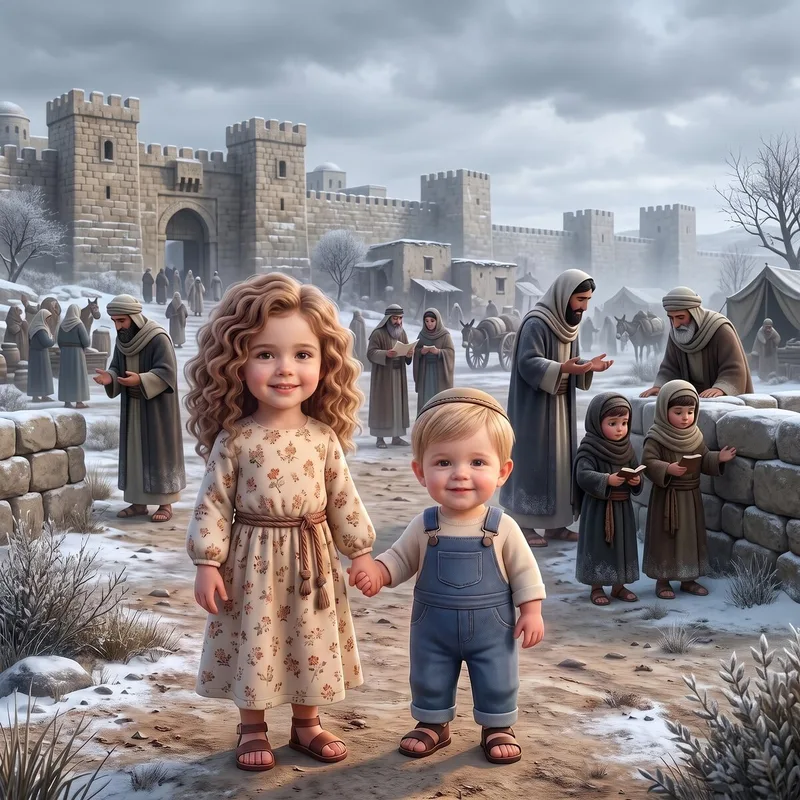
The Navi tells us in Sefer Melachim (II 25:1) and again in Sefer Yirmiyahu (52:4) that in the ninth year of Tzidkiyahu's reign, on the tenth day of the tenth month, Nevuchadnetzar came against Yerushalayim with his whole army. They camped around the city and built siege works around it. The pesukim tell us the siege continued until the eleventh year of Tzidkiyahu's reign, when the city was breached.
Far away in Bavel, among the exiles, the Navi Yechezkel received a message on that same date. The pasuk says he was told to write down the name of this very day, because the king of Bavel had laid siege to Yerushalayim on this very day (Yechezkel 24:1-2). So the date itself is recorded in Nevi'im.
Yirmiyahu had been warning Klal Yisrael to do teshuvah long before this. During the siege he was thrown into a pit for what he said, and Eved-Melech got him out. You can read that part in our article on Yirmiyahu saved from the pit.
Why do we fast on a day when nothing was destroyed yet?
This is the question a sharp eight-year-old will ask, and it is a good one. A simple answer is that the siege is where the road to the Churban began, and the fast is about waking up, not only about remembering the worst moment.
The Navi Zecharyah calls this day tzom ha'asiri, the fast of the tenth month, one of four fasts he names (8:19). Chazal explain that the fast of the tenth month is Asarah B'Teves. Zecharyah also says these days will one day become joy and gladness and good Yomim Tovim for Yehuda, and he adds that we should love truth and peace.
The Rambam writes (Hilchos Taanios 5:1) that the fast days remember tragedies that befell Klal Yisrael in order to awaken our hearts and open the paths of teshuvah. Children can hold on to that sentence: a fast day is a day to wake up and do better.
What can children learn from Asarah B'Teves?
Three ideas work well at home. These are lessons families draw from the story, not statements of Chazal on the day itself.
- Listen to a warning early. Yirmiyahu spoke for years, and it is easier to fix something when it is small.
- Care about what we lost. A child can learn to miss the Beis HaMikdash even without ever having seen it.
- Turn sadness into action. The goal of the fast is teshuvah, so a child can choose one small thing to do better, such as davening with more kavanah or speaking more kindly.
Asarah B'Teves also connects to Tzom Gedaliah, another of the four fasts Zecharyah names, which makes a good follow-up for older children.
How do I explain Asarah B'Teves to a 3-year-old, a 6-year-old and a 10-year-old?
Ages 3 to 4. Keep it to a few sentences: "Today is a sad day for Yidden. Long ago an army surrounded Yerushalayim, where our Beis HaMikdash was. Today the big people don't eat, and we ask Hashem to bring Moshiach." A board book (ages 0-4) suits this age, and there is no need to describe anything scary.
Ages 6 to 7. Tell the sequence: Yirmiyahu warned, the people did not listen, and the siege began. Then ask what we can do when someone who cares about us gives us a warning. A softcover (ages 4-8) fits here, and this age enjoys picking one small thing to improve.
Ages 9 to 12. Bring in Zecharyah and the Rambam. Ask why a fast day is meant to awaken the heart, and what it means that these days will one day become days of joy. This is also a good age to connect the four fasts to each other, since a hardcover (ages 5-18) stays relevant for years.
Do children fast on Asarah B'Teves?
Children below bar or bas mitzvah age are not required to fast. Girls from 12 and boys from 13 are the ones who take on the fast, and the fast begins at dawn and lasts until nightfall.
Some parents like to give a younger child a small way to take part, such as skipping a treat or saying one extra perek of Tehillim. Whether and how to train a particular child is a question for your rav, and a child who needs to eat should simply eat.
What is the personalized Asarah B'Teves book like?

Softcover 8″×8″

Hardcover 8″×8″

Board book 6″×6″

Coloring book 8.5″×11″
The Asarah B'Teves story is in the Holidays collection at Torah Tale. Your child's name and, from one uploaded photo, their likeness appear on every page, illustrated in 3D animated-film style. Up to eight siblings can appear in the same book, ages 0 to 18.
There are three formats: a board book 6"x6" with rounded safety corners (ages 0-4), a softcover photo book 8"x8" (ages 4-8) and a hardcover photo book 8"x8" (ages 5-18). Softcover and hardcover open with a dedication page. If you add parents and grandparents, they appear with the children on a closing family page in every format.
Every book ends with a discussion page of 10 questions that mix comprehension with middos, so it works as something to talk about and not only something to read to your child. An optional matching coloring book is a weekday activity, for an afternoon during the week. The book can be read on Shabbos, and the story is written with careful rabbinical guidance and strict tznius.
What questions can we ask at the Shabbos table before the fast?
These are for talking only, at the Shabbos table or at supper on a weekday:
- What happened to Yerushalayim on the tenth of Teves?
- Why do you think Hashem sent Yirmiyahu to warn Klal Yisrael?
- When someone warns us, what is hard about listening?
- What is one small thing we can fix this week?
- Why do you think the Navi says these fasts will one day become days of joy?
If a younger child asks why Abba or Ima is not eating, a one-sentence answer works: "Today we remember the day the trouble began for Yerushalayim, and we fast to remind ourselves to do teshuvah." Chanukah comes just before this fast, so the Chanukah story is a hopeful companion to read first.
When you are ready, create the book. It takes a free account and a few short questions, about five minutes in all. US standard shipping arrives in about 12 business days, counted from the order, so it helps to order a few weeks ahead.
Frequently asked questions
What is Asarah B'Teves and why do we fast?
Asarah B'Teves is the fast on the tenth of Teves, the day Nevuchadnetzar began his siege of Yerushalayim. The siege continued until the city was breached in the eleventh year of Tzidkiyahu's reign. The Rambam writes that the fast days remember tragedies that befell Klal Yisrael in order to awaken our hearts and open the paths of teshuvah.
When is Asarah B'Teves?
It is on the tenth of Teves, which comes in the weeks after Chanukah. Check your luach for the exact secular date and for the times the fast begins and ends.
Do children fast on Asarah B'Teves?
Children below bar or bas mitzvah age are not required to fast. Some families teach older children to give up a treat as a way of joining in, but how to train a child is a question for your rav.
How do I explain Asarah B'Teves to a young child?
Keep it short and gentle: it is a sad day for Yidden because an army once surrounded Yerushalayim, where the Beis HaMikdash stood. The grown-ups do not eat today, and we ask Hashem to help us do teshuvah and to bring Moshiach. You do not need to describe anything frightening to explain why the day matters.
What is the lesson of Asarah B'Teves for children?
One lesson families take from it is to listen to a warning and fix things early, the way Yirmiyahu urged Klal Yisrael to do before the siege. Another is to care about what Klal Yisrael lost and to long for the Beis HaMikdash. A third is that a fast is meant to lead to teshuvah, not only to sadness.
Is there a personalized book for Asarah B'Teves?
Yes, Torah Tale has a personalized book of this story in its Holidays collection, with your child's name and likeness on every page in 3D animated-film style. It ends with a discussion page of 10 questions mixing comprehension with middos, and it can be ordered in English, Hebrew or Yiddish.