Purim Katan (פורים קטן) for Kids: Adar I, Little Purim & How to Explain It
Purim Katan is the 14th of Adar I in a leap year. Here is how to explain it to young children, retell the Purim story in a few sentences, and add a little simcha to the day.
Published by Torah Tale.
Create this book for your child
Purim Katan, "little Purim," is the 14th of Adar I in a leap year, a day that quietly reminds us that Purim is coming. For children it is an easy, happy hook: a small day with a small simcha, and a good reason to retell the Purim story a month before the big one. This year, 5787, is a leap year, so it falls in February 2027 (check your luach for the exact date).
What is Purim Katan and why do we have it?
In a leap year the Jewish calendar has two months of Adar. Chazal teach that the Megillah is read, and matanos la'evyonim are given, in the second Adar (Megillah 6b), so real Purim is on the 14th of Adar II.
The 14th of Adar I is still kept as a smaller day. We do not fast or give eulogies, Tachanun is omitted, and the Rema writes that it is proper to add a little to the meal and the simchah. Many also omit Tachanun on the 15th; ask your rav what your family does.
What is the Purim story, in a few sentences for kids?
Achashveirosh was king over a huge empire, and Haman, his minister, wanted to destroy the Yidden because Mordechai would not bow to him. The Megillah tells us Haman cast a pur, a lot, to choose the day, and it fell on the month of Adar (Esther 3:7).
Esther, who had become queen, asked the Yidden to fast and daven for three days (Esther 4:16), and then she went to the king. Hashem's hand was hidden all through the story. Haman's plan was turned around, Mordechai was honored, and the Yidden defended themselves and were saved. The full retelling is in The Purim Story for Kids.
What is the lesson of Purim Katan for children?
The simplest lesson is that simcha takes preparation. Chazal teach that when Adar comes in we increase simcha (Taanis 29a). Purim Katan is a small step on the way, so a child can feel the happiness building before the big day.
A second lesson is hakaras hatov. The Yidden were saved, so we remember it. We do not need to wait for the Megillah to say thank you to Hashem for what He did for us then, and does for us now.
A third lesson is that small things matter. The day is called "katan," and it still counts. Children understand this well, because they are often told they are too little for things, and here is a day that is little and still special.
How do I explain Purim Katan to a 3-year-old, a 6-year-old and a 10-year-old?
Ages 3 to 4: Keep it to one sentence and one action. "Today is little Purim. Hashem saved the Yidden, so we are a bit happy today." Then sing a Purim song, or have a special treat after supper.
Ages 6 to 7: Tell the story in order: Haman wanted to hurt the Yidden, Esther and Mordechai asked everyone to daven, and Hashem turned it around. Then explain why there is a little Purim now: this year has two months of Adar, and the big Purim is next month.
Ages 9 to 12: Explain the calendar question. A leap year adds a month, the Megillah is read in Adar II, and Adar I still gets a day that remembers Purim. Ask your child why they think Chazal wanted something to mark it. If the question comes up why we do not read the Megillah or give mishloach manos, you can tell them these belong to the real Purim, and for finer details suggest they ask the rav.
What can we do at home on Purim Katan?
Keep it light and keep it real. A nicer supper, a bit of singing, or sitting together to retell the story is plenty. This is also a good time to start working on the Purim preparations that come up each year, like deciding on costumes or choosing whom to send mishloach manos to on the real Purim.
Ask a few questions at the table:
- Why do you think Haman could not see that Hashem was running the story?
- What did Esther do first, before going to the king?
- What can we do today to be a little happier, and to make someone else happy?
- If Purim is next month, why do you think Chazal gave us a small day now?
What is a personalized Purim Katan book like?
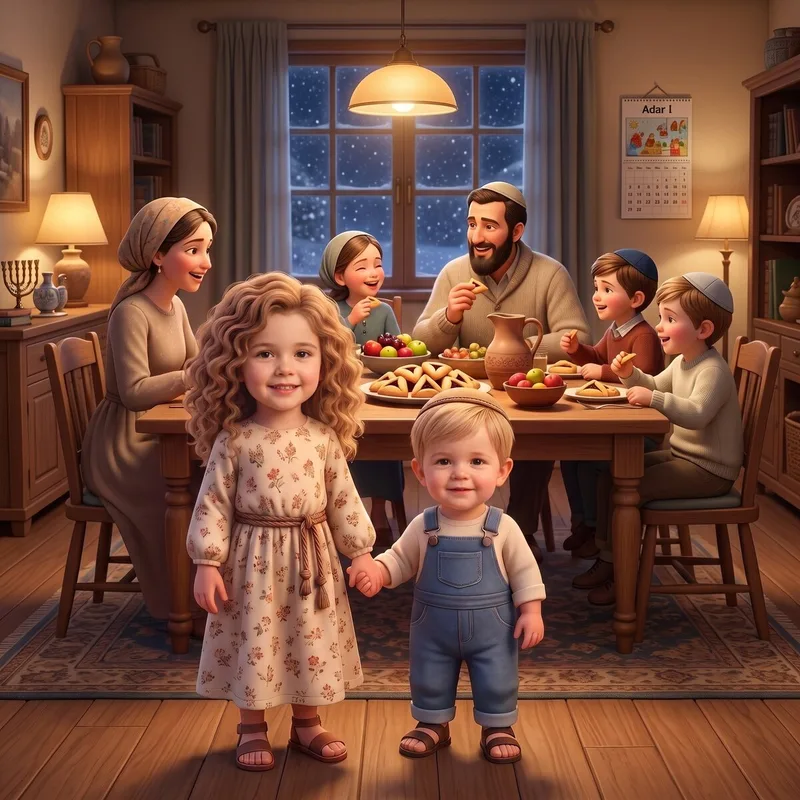
Torah Tale's Purim Katan book is part of the Holidays collection. Your child is the hero: their name and, from one uploaded photo, their likeness appear on every page, illustrated in 3D animated-film style. Up to eight children, ages 0 to 18, can appear in the same book, so siblings can share one story.

Softcover 8″×8″

Hardcover 8″×8″

Board book 6″×6″

Coloring book 8.5″×11″
Formats follow age: a 6x6 board book with rounded safety corners (ages 0-4), an 8x8 softcover (ages 4-8), and an 8x8 hardcover (ages 5-18). The softcover and hardcover open with a dedication page. If you add parents, grandparents and other relatives with their photos, they appear with the children on a closing family page in every format.
Every book ends with a discussion page of ten questions that mix comprehension with middos, what happened and what it asks of the child. That page is what turns a book you read to your child into something you talk about together at the table. Books are written with careful rabbinical guidance and strict tznius, and reviewed by our team before they go to print.
Reading is welcome at any time, including Shabbos and Yom Tov. The optional matching coloring book (8.5x11, black-and-white line art) is a one-time add-on and a weekday activity only, for an afternoon during the week.
How do I order a Purim Katan book?
Creating a book takes about five minutes. You need a free account and a few short questions: each child's name, boy or girl, age and one photo, any siblings, the story, your community (asked once), the language (English, Hebrew or Yiddish) and the printed format. You can order a single book, or a collection subscription if you want to build a set of the Holidays collection. For shipping and plan details see pricing.
Purim Katan is only a day, but a book lasts, and it will be waiting when the next Adar comes around. If you want to read about the next stop on the calendar, see Taanis Esther for Kids. When you are ready, you can create the book and put your own child into the story.
Frequently asked questions
What is Purim Katan?
Purim Katan is the 14th of Adar I in a leap year, and the name means "little Purim." In a leap year the Megillah is read in Adar II, but Adar I still carries a reminder of Purim. We do not fast or give eulogies on the day, and Tachanun is omitted.
When is Purim Katan in 2027?
This Hebrew year, 5787, is a leap year, so Purim Katan falls in Adar I, in February 2027. Check your luach for the exact date and for local minhagim about the 15th as well.
Do we read the Megillah or give mishloach manos on Purim Katan?
No. The Megillah reading and matanos la'evyonim belong to Adar II. The Rema writes that it is proper to add a little to the meal and the simchah on Purim Katan, and many families do this with a nicer meal or some singing. For any specific question, ask your rav.
How do I explain Purim Katan to a 4-year-old?
You can say: "Today is little Purim. We remember that Hashem saved the Yidden, and we are a bit happier today." Then add something small and concrete, like a special treat at supper or singing a Purim song together.
Is there a personalized Torah Tale book for Purim Katan?
Yes. Purim Katan is in the Holidays collection, and the book stars your child, with their name and likeness illustrated in 3D animated-film style. It comes as a 6x6 board book with rounded safety corners (ages 0-4), an 8x8 softcover (ages 4-8) or an 8x8 hardcover (ages 5-18), and ends with a discussion page of ten questions.
Can I add a coloring book to a Purim Katan book?
Yes, a matching 8.5x11 black-and-white coloring book is an optional one-time add-on to a book. Coloring is a weekday activity, so save it for a weekday afternoon, never Shabbos or Yom Tov.