Hanukkah Foods Kids Love, and Why We Eat Them
Latkes, sufganiyos and cheese are the foods children wait for all year. Here is what each one is, where the minhag comes from, which kitchen jobs a 3-year-old and a 10-year-old can really do, and how the two Shabbosos of Chanukah 2026 change the frying schedule.
Published by Torah Tale.
The traditional Chanukah foods are foods fried in oil, mainly latkes and sufganiyos, together with dairy foods such as cheese. (Hanukkah and Chanukah are two spellings of the same Yom Tov.) The fried foods are a minhag recalling the nes of the pach shemen, and the cheese is a separate minhag connected to the story of Yehudis. Neither one is an obligation of the day, and every family keeps what it has from home.
What are the traditional Chanukah foods?
Here is the whole list as it actually appears on most tables:
- Latkes - fried pancakes, today usually grated potato with egg, onion and a little flour.
- Sufganiyos - fried doughnuts, often filled with jelly and dusted with sugar.
- Dairy - cheese, cheese latkes, blintzes, a dairy meal on one of the nights.
- Gelt and chocolate coins - nosh rather than a food of the day, but part of the week in most homes.
The Shulchan Aruch writes that the meals of Chanukah are not an obligation the way the Purim seudah is. The Rama adds that it is the minhag to say zemiros and shevachos at them, and then they are a seudas mitzvah. That is worth telling children: the latke is not the mitzvah, but the table where the nes is talked about is something real.
Why do we eat latkes on Chanukah?
Because of the oil. The Gemara (Shabbos 21b) relates that when the Chashmonaim came into the Beis HaMikdash they searched and found one small flask of oil still sealed, enough to burn for one day, and it burned for eight days until new oil could be prepared. Eating food fried in oil is a minhag that puts that nes on the plate in front of a child.
It helps to say plainly that the minhag is about the oil and not about the potato. Latkes have been made of cheese, of flour and of other things; the potato version is what most of us grew up on. When a four-year-old asks why the latke is greasy, the honest answer is that the grease is the whole idea.
If you want the story itself rather than a summary, we wrote it out for children in The Chanukah Story for Kids.
What are sufganiyot, and how do you serve them to kids?
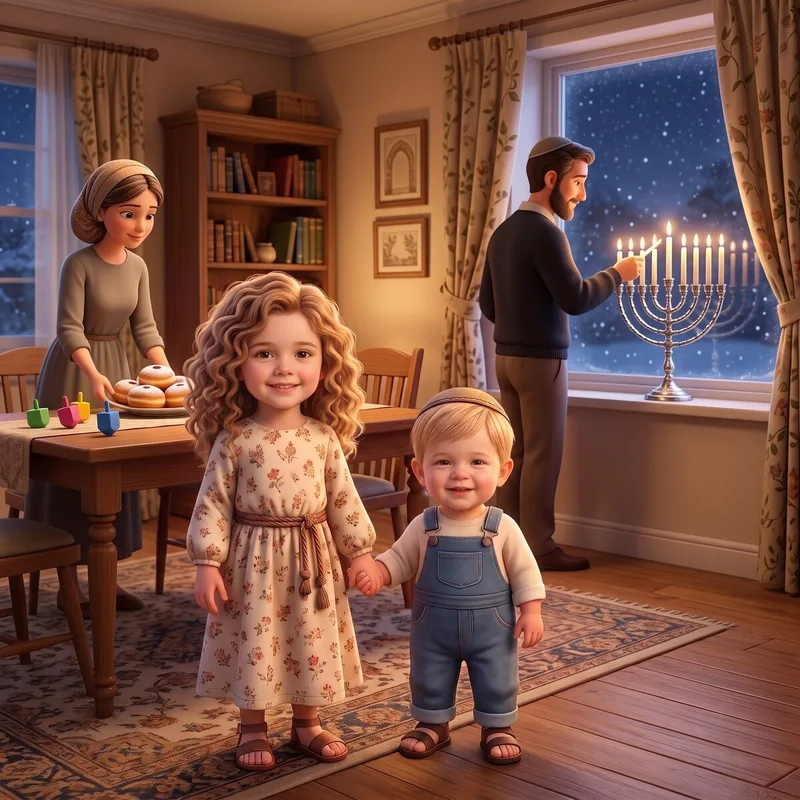
Sufganiyos are fried doughnuts, usually round, often filled with jelly and covered in sugar. Children love them and parents dread them, and both reactions are correct. A few things make them manageable:
- Make or buy small ones. A full-size doughnut per child on each of eight nights is a lot of sugar and a lot of leftover halves.
- Serve them over a plate, sitting down, with a napkin already in hand. Jelly travels.
- Add the sugar at the table, not in the kitchen, so the floor stays usable.
- Don't do them every night. Alternate: latkes one night, doughnuts the next, a dairy supper on another.
If you fry at home, the pot of hot oil is an adults-only zone from the moment it goes on the fire until it is cool and put away. Children help before and after, never beside it.
Why do some families eat dairy on Chanukah?
The Rama (Orach Chaim 670:2) brings the minhag to eat cheese on Chanukah, connected to the story of Yehudis. She was a brave Jewish woman who brought the enemy commander cheese and wine, and through her the city she lived in was saved. The minhag remembers that the yeshuah of Chanukah came through people who were willing to act, not only through soldiers.
Practically, that makes a dairy supper one night a good solution: cheese latkes, blintzes, baked ziti, something the children can help assemble. Communities differ in how much weight they give this minhag, so keep to what your family does.
Kitchen jobs for children, by age
This is the part worth printing and sticking on the fridge during the weekday afternoons of Chanukah. Frying belongs to an adult at every age.
| Age | Jobs that really work |
|---|---|
| 2 to 3 | Scrubbing potatoes in a bowl of water, carrying unbreakable bowls, counting doughnuts onto a platter, putting napkins at each place |
| 4 to 5 | Measuring flour, cracking eggs into a separate cup, stirring batter at the table, sprinkling sugar, setting out plates |
| 6 to 8 | Grating with a guard and close supervision, mixing the full batter, squeezing jelly into doughnuts, peeling onion skins |
| 9 to 12 | Reading the recipe aloud and running it, grating, shaping latkes onto a tray for an adult to fry, serving the table, washing up |
Two safety lines that are worth saying out loud each year: nobody carries a hot pan, and nobody stands next to the pot. Younger children can hold the unlit candles before lighting and bring them to Totty, which gives them a job at the menorah too, well away from matches and flame. For more to do in the daylight hours, see Hanukkah activities for each night.
How does the 2026 calendar change the cooking plan?
Chanukah 2026 begins Friday evening, December 4 (25 Kislev 5787), so the first night is erev Shabbos and that night's licht are lit before the Shabbos candles. Night 2 is Motzei Shabbos, December 5. Night 6, Wednesday December 9, is when Rosh Chodesh Teves begins. The eighth night falls on Friday, December 11, again before the Shabbos candles, and the last day, Zos Chanukah, is Shabbos, December 12.
That means two Fridays of frying and two Shabbos seudos inside Chanukah. Anything fried for those seudos is made before Shabbos; frying on Shabbos is melacha. How your family warms food on Shabbos itself follows your own practice and your rav. Many women have the minhag not to do certain melachos while the licht are burning, roughly the first half hour, which is one more reason to get the latkes done before candle lighting on the weekday nights as well. We laid out the full two-Friday schedule in Hanukkah on Shabbat 2026.
What to talk about while the latkes are on the table
Food is the easiest opening of the year. A few questions that work on children of different ages:
- Why is there oil in this doughnut? What does the oil remind us of?
- Which was the bigger nes: finding the sealed flask, or that it lasted eight days?
- The Chashmonaim could have waited for new oil. Why did they light right away with what they had?
- Who in our family did something today so this table would be ready?
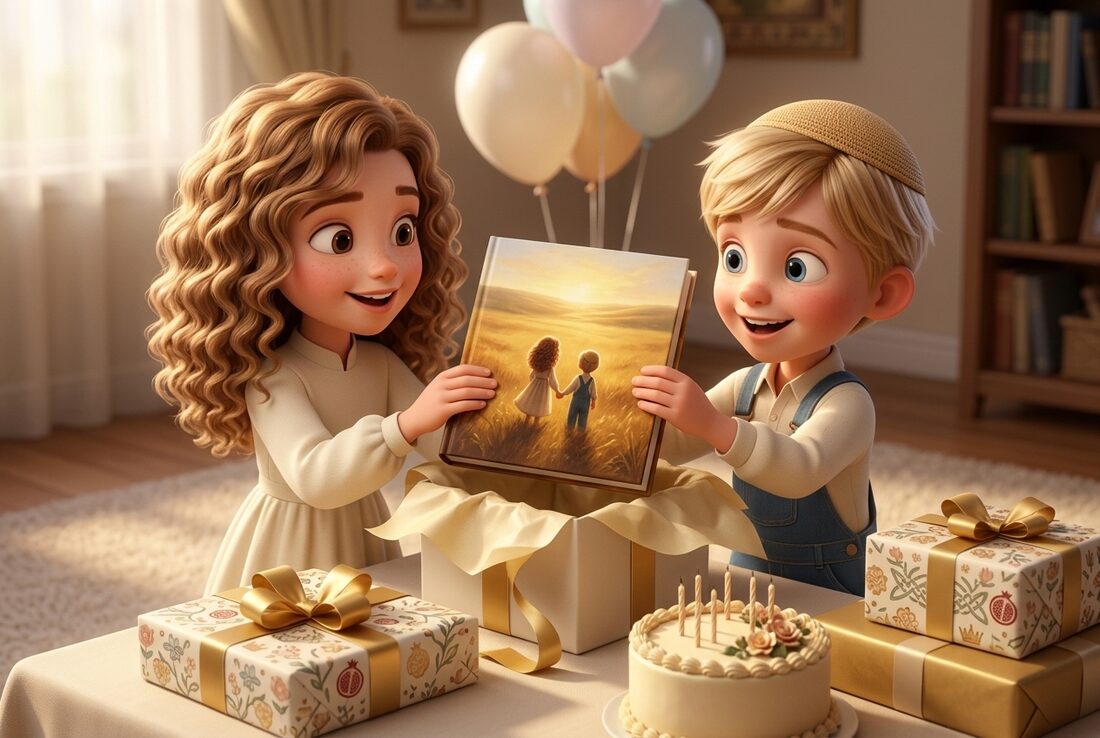
This is also where a book earns its place. Reading is entirely appropriate on Shabbos and on a long Chanukah afternoon, and a Chanukah story the children already star in gets asked for again. The Chanukah book in the Torah Tale Holidays collection puts your own child into the story: their name, and from one uploaded photo their likeness, illustrated in high-resolution 3D animated-film style on every page. Up to eight siblings can appear in the same book, ages 0 to 18. Every book ends with a dedicated discussion page of ten questions about the story, mixing comprehension with middos, which is exactly the kind of thing that keeps a table talking after the plates are cleared.

Softcover 8″×8″

Hardcover 8″×8″

Board book 6″×6″

Coloring book 8.5″×11″
Formats are a 6x6 board book with rounded safety corners for ages 0 to 4, an 8x8 softcover for ages 4 to 8, and an 8x8 hardcover for ages 5 to 18. Softcover and hardcover open with a dedication page. There is also an optional matching 8.5x11 coloring book in black-and-white line art, which is a weekday activity only, for an afternoon before Shabbos or one of the weekdays of Chanukah, never on Shabbos itself.
Ordering in time for one of the nights
Creating a book takes about five minutes: a free account and a few short questions (each child's name, boy or girl, age and one photo, any siblings, the story, your community, asked once, the language and the format). Books are available in English, Hebrew and Yiddish.
US standard shipping arrives in about 12 business days, counted from the order, and Thanksgiving, Thursday November 26, is not a business day, so a book ordered this week is best aimed at one of the later nights rather than the first. US express exists and is faster once the book goes to print. We ship worldwide, with rates shown at checkout. If you are already close to the wire, see last-minute Chanukah gifts that still arrive in time.
Fry the latkes, let the children grate and fill and sprinkle, and tell them why the oil is there. When you want the story in their hands as well, you can create the book with your child as the hero of it.
Frequently asked questions
What foods do you eat on Hanukkah?
The traditional Chanukah foods are foods fried in oil, above all latkes (fried pancakes, today usually potato) and sufganiyos (fried doughnuts, often filled with jelly). Many families also eat dairy foods such as cheese, cheese latkes or blintzes. Chocolate gelt and other nosh are part of the week in most homes too. None of these is an obligation of the day; they are minhagim, and families keep the ones they have.
Why do we eat latkes on Hanukkah?
Latkes are fried in oil, and the oil is the point. The Gemara (Shabbos 21b) relates that when the Chashmonaim came into the Beis HaMikdash they found one small flask of oil still sealed, enough for one day, and it burned for eight days until new oil could be brought. Eating foods fried in oil is a minhag that puts that nes on the table where children can see it. The minhag is about the oil, not about the potato.
Are sufganiyot and jelly doughnuts the same thing?
Sufganiyot (sufganiyos) are fried doughnuts, usually round and often filled with jelly and dusted with sugar. They are the same idea as a jelly doughnut, and the name is the one used in Israel and in most frum homes on Chanukah. For young children, small ones served over a plate with the sugar added at the table save a great deal of mess.
Why do some families eat dairy on Hanukkah?
The Rama (Orach Chaim 670:2) brings the minhag of eating cheese on Chanukah, connected to the story of Yehudis, a brave Jewish woman who brought cheese and wine to the enemy commander and through whom her city was saved. Some families keep this with cheese latkes or blintzes on one of the nights. Like the fried foods, it is a minhag rather than a chiyuv, and practice varies from home to home.
Can we fry latkes on Shabbos Chanukah?
No. Cooking and frying are melacha, so anything fried for a Shabbos seudah has to be made before Shabbos. In 2026 this matters twice: Chanukah begins Friday evening, December 4, and the eighth night is Friday, December 11, with Shabbos Zos Chanukah on December 12. How food is warmed on Shabbos itself depends on your family's practice, so follow your rav.
What can young children help with in the Chanukah kitchen?
Plenty, as long as they are away from the hot oil. Toddlers can scrub potatoes, carry unbreakable bowls and count doughnuts onto a platter. Children of about four to seven can measure flour, crack eggs and stir batter at the table rather than at the stove. From roughly eight and up, children can grate, mix a full batter, fill doughnuts and serve. Frying stays with an adult at every age.