Hanukkah Blessings for Kids: The Brachos on the Licht
On the first night of Chanukah we say three brachos over the licht and two on every night after. Here is the Hebrew, what each bracha means, how Haneiros Halalu and Maoz Tzur fit in, and how to teach them to a 4-year-old and to a 10-year-old.
Published by Torah Tale.
On the first night of Chanukah we say three brachos before lighting the licht, and on each of the next seven nights we say two. The Hanukkah blessings are short, they are the same every year, and a child of five or six can learn to say them by heart if he hears them clearly a few times. Below are the brachos in Hebrew with their meaning, then Haneiros Halalu and Maoz Tzur, and then a plan for teaching them by age.
What brachos do we say on the Chanukah licht?
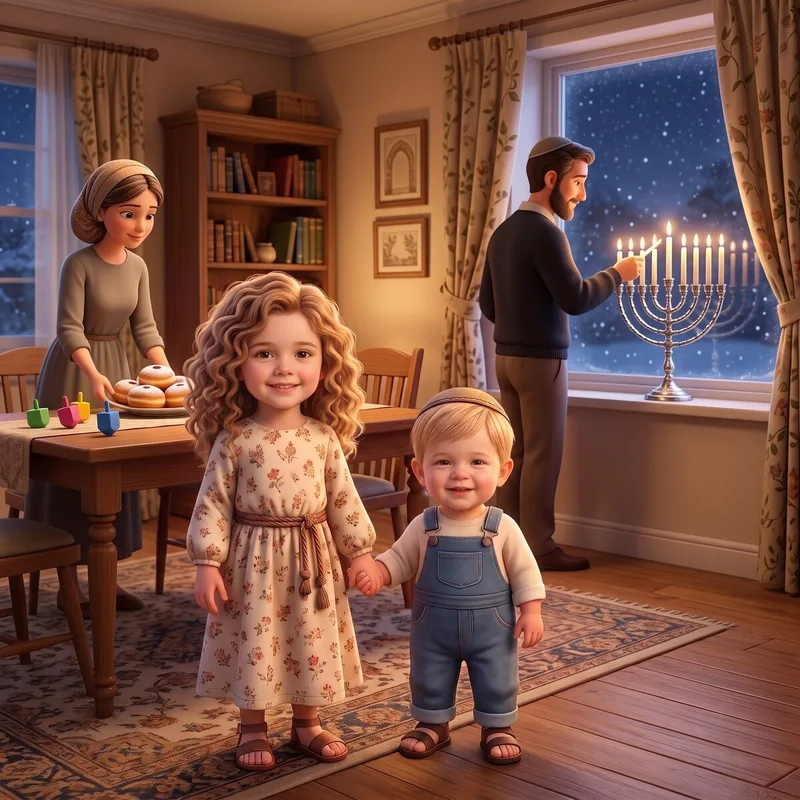
All the brachos are said before any light is kindled, while the shamash is already burning in your hand. Then the lights are lit, and Haneiros Halalu is said as the rest go up.
- ברוך אתה ה' אלוקינו מלך העולם, אשר קידשנו במצוותיו וציוונו להדליק נר של חנוכה. Baruch atah Hashem Elokeinu Melech ha'olam, asher kideshanu b'mitzvosav v'tzivanu l'hadlik ner shel Chanukah. This is the bracha on doing the mitzvah: Hashem made us holy with His mitzvos and commanded us to light a Chanukah light. Some nuschaos have ner Chanukah rather than ner shel Chanukah; say it as it appears in your family's siddur.
- ברוך אתה ה' אלוקינו מלך העולם, שעשה ניסים לאבותינו בימים ההם בזמן הזה. She'asa nisim la'avoseinu bayamim haheim bizman hazeh. Hashem did nisim for our fathers, in those days, at this time of year. This is the bracha that turns a candle into a story.
- ברוך אתה ה' אלוקינו מלך העולם, שהחיינו וקיימנו והגיענו לזמן הזה. Shehecheyanu v'kiyemanu v'higi'anu lazman hazeh. Thank You for keeping us alive and bringing us to this time. This one is said on the first night only, because it is said the first time in the year that we do the mitzvah.
Someone who did not light at all on the first night says Shehecheyanu on the first night he does light. If a question comes up in your home, ask your rav.
Which nights get three brachos and which get two?
Here is Chanukah 2026 night by night. Two of the eight nights fall on erev Shabbos this year, which changes the time of lighting but not the brachos.
| Night | Date | Brachos | Note |
|---|---|---|---|
| 1 | Friday, December 4 | Three | Erev Shabbos: light the Chanukah licht before the Shabbos candles |
| 2 | Motzei Shabbos, December 5 | Two | Families differ on whether havdalah or the licht come first; follow your minhag and your rav |
| 3 | Sunday, December 6 | Two | |
| 4 | Monday, December 7 | Two | |
| 5 | Tuesday, December 8 | Two | |
| 6 | Wednesday, December 9 | Two | Rosh Chodesh Teves begins |
| 7 | Thursday, December 10 | Two | |
| 8 | Friday, December 11 | Two | Erev Shabbos again; Zos Chanukah is Shabbos, December 12 |
For a fuller look at how the two Shabbosos shape the week, see Hanukkah on Shabbat 2026: Two Fridays, Two Shabbosos and the night-by-night plan for 2026.
Haneiros Halalu for kids: what the words actually say
After the first light is kindled, Haneiros Halalu is said while the rest of the lights go up. The text is recorded in Masechta Soferim, and nuschaos differ slightly in a word or two.
הנרות הללו אנו מדליקין על הניסים ועל הנפלאות ועל התשועות ועל המלחמות שעשית לאבותינו בימים ההם בזמן הזה על ידי כהניך הקדושים. וכל שמונת ימי החנוכה הנרות הללו קודש הם, ואין לנו רשות להשתמש בהם אלא לראותם בלבד, כדי להודות ולהלל לשמך הגדול על ניסיך ועל נפלאותיך ועל ישועתך.
For a child, three ideas are enough. First: we are lighting these lights because of what Hashem did, the nisim and the yeshuos, through the kohanim. Second: these lights are kodesh for all eight days. Third, and this is the one children remember: we are not allowed to use them, only to look at them. You cannot read by the Chanukah licht, you cannot find a lost sock by them, and the minhag is not to light one candle from another, which is one reason the shamash is there. Say that line once a night while the lights burn and a five-year-old will be explaining it to a guest by night four.
What about Maoz Tzur?
Maoz Tzur is a zemer sung after the lighting in many homes. It is not part of the mitzvah and it is not a bracha, which is worth telling an older child so he knows the difference between what we must say and what we sing. The opening letters of its stanzas spell out the name Mordechai, understood to be the name of the author, and the stanzas move through different times when Yidden were saved. Some communities say Mizmor Shir Chanukas HaBayis (Tehillim 30) at the lighting as well. Children usually learn the first stanza in cheder; sing it every night and the rest comes on its own.
How to teach the brachos by age
The brachos are short enough to teach by repetition, not by drilling. Here is what works at different ages.
- Ages 3-4. Do not expect words yet. Give the child a safe job: carrying the unlit candles to the table, or counting the candles out loud with you. Never let a young child near matches, a lighter, oil or a burning flame. Say one phrase with him every night, the same one: she'asa nisim la'avoseinu, and tell him it means Hashem did nisim for us.
- Ages 6-7. Teach the first bracha fully. Say it slowly, let him repeat it after you phrase by phrase, and point out the last three words, ner shel Chanukah, which tell you which mitzvah you are about to do. By the middle of Chanukah he can say the whole bracha before you light.
- Ages 9-12. Go into the second bracha properly. Ask why we thank Hashem for nisim that happened long ago, and what bizman hazeh, at this time, is doing in the sentence. This is also the age to read Haneiros Halalu from the siddur rather than from memory, and to notice that it never asks for anything. It is all thanks.
In many homes a boy old enough to be trained in the mitzvah lights his own menorah and says the brachos himself, with a parent beside him. Minhagim differ from family to family and community to community, including about girls lighting and about the minhag many women have not to do certain work while the lights burn. Ask your rav.
What do we talk about for the half hour the candles burn?
The licht have to burn a good while, and nobody is using them for anything. That half hour is the most natural talking time of the whole Yom Tov, and a story is the easiest thing to fill it with. If the children do not yet know the story behind the brachos, our article on the Chanukah story for kids lays out the flask of oil and the eight nights in order.
The personalized Chanukah book from the Holidays category of our story picker puts your own child inside that story, with his name and his face, drawn in 3D animated-film style from one uploaded photo. Up to eight siblings can appear in the same book. Every book ends with a dedicated discussion page of ten questions about the story, mixing comprehension with middos, which is exactly the kind of thing you want in your hand while the candles are burning down and nobody wants to get up. Reading is entirely appropriate on Shabbos too, which matters this year with Shabbos Chanukah on December 5 and Zos Chanukah on Shabbos, December 12.

Softcover 8″×8″

Hardcover 8″×8″

Board book 6″×6″

Coloring book 8.5″×11″
If you want the book for the first night, when do you order?
US standard shipping arrives in about 12 business days, counted from the order, and Thanksgiving on Thursday, November 26 is not a business day. A book meant for the first night, Friday evening December 4, should be ordered by about Monday, November 16. A gift for one of the later nights has a few more days. US express exists and is faster once the book goes to print. We cannot promise a delivery date, so order early rather than close.
Choose the format by age: the 6x6 board book with rounded safety corners for ages 0-4, the 8x8 softcover for ages 4-8, the 8x8 hardcover for ages 5-18. The softcover and hardcover open with a dedication page, and if you add parents and grandparents with their photos, they appear with the children on a closing family page in every format. There is also an optional matching 8.5x11 black-and-white coloring book, which is a weekday activity: a Chanukah afternoon that is not Shabbos, or the days before Chanukah while you are waiting.
Creating a book takes about five minutes. It needs a free account and a few short questions: each child's name, boy or girl, age and one photo, any siblings, the story, your community (asked once), the language (English, Hebrew or Yiddish) and the printed format. Create the book with the Chanukah story already chosen, and have something to read while the licht burn.
Frequently asked questions
How many blessings do we say on the first night of Hanukkah?
Three. We say the bracha on lighting (l'hadlik ner shel Chanukah), the bracha thanking Hashem for the nisim He did for our fathers (she'asa nisim la'avoseinu bayamim haheim bizman hazeh), and Shehecheyanu. On nights two through eight only the first two are said, because Shehecheyanu is for the first time we do the mitzvah that year.
What are the Hanukkah candle blessings in Hebrew?
The first is Baruch atah Hashem Elokeinu Melech ha'olam, asher kideshanu b'mitzvosav v'tzivanu l'hadlik ner shel Chanukah. The second ends she'asa nisim la'avoseinu bayamim haheim bizman hazeh. The third is Shehecheyanu v'kiyemanu v'higi'anu lazman hazeh. Siddurim differ slightly in wording between nuschaos, so say the brachos the way your family's siddur has them.
What is Haneiros Halalu and when is it said?
Haneiros Halalu is a short paragraph said at the lighting, after the first light is kindled, while the remaining lights are being lit. It says that these lights are for the nisim and the yeshuos Hashem did for our fathers in those days at this time, that all eight days of Chanukah they are holy, and that we may not use them, only look at them. The text is recorded in Masechta Soferim. Some families say it after all the lights are kindled; follow your own minhag.
Do children say the brachos on the Chanukah licht?
In many homes a child who is old enough to be trained in the mitzvah lights his own menorah and says the brachos himself, and a parent stands next to him. Practice differs from family to family and community to community, including regarding girls lighting. Ask your rav how it is done in your family, and never let a young child handle matches or oil.
On Friday, December 4, 2026, when do we light?
The first night of Chanukah 2026 falls on erev Shabbos. The Chanukah licht are lit before the Shabbos candles, and the brachos are the same three. Because the lights have to burn well into the night, enough oil or long enough candles are needed. The eighth night, Friday December 11, works the same way.
Is Maoz Tzur part of the brachos?
No. Maoz Tzur is a zemer sung after the lighting in many homes, not part of the mitzvah. Its stanzas open with the letters of the name Mordechai, understood to be the name of the author, and it looks back at yeshuos Hashem brought in different times. Some communities say Mizmor Shir Chanukas HaBayis at the lighting as well.